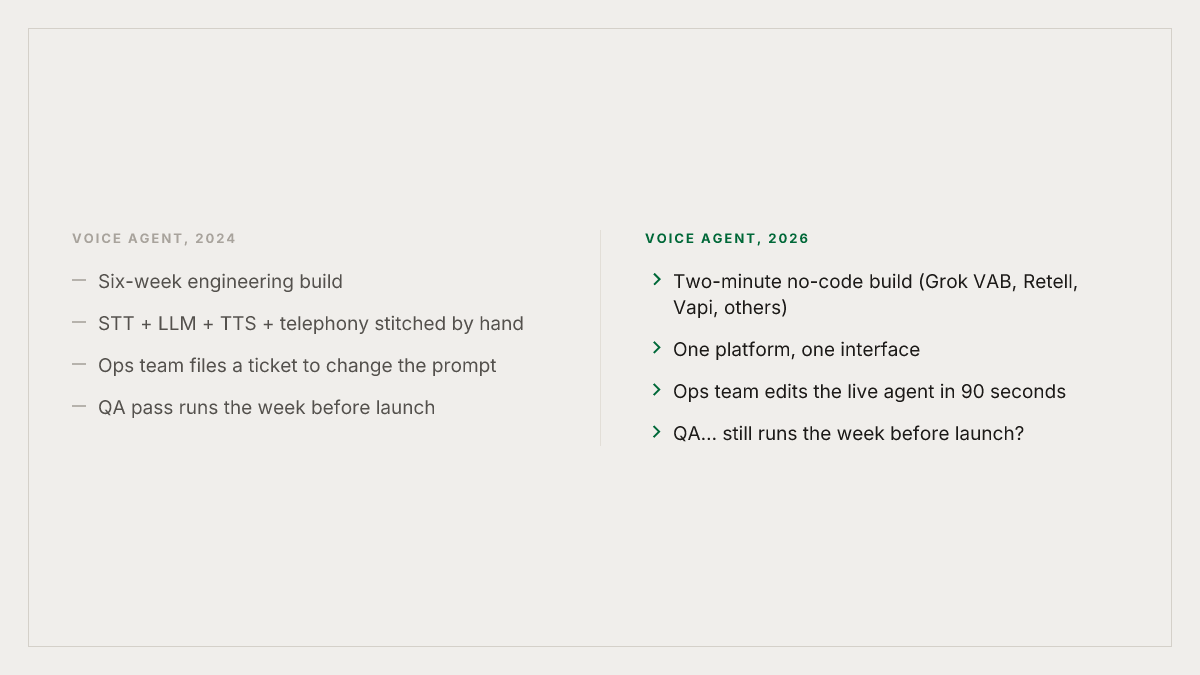
Two weeks ago, standing up a production voice agent still meant stitching together a speech-to-text vendor, an LLM, a text-to-speech vendor, telephony, a knowledge base, guardrails, and observability. On July 1, xAI shipped Voice Agent Builder in beta, a no-code console that promises "a personalized voice agent in under 2 minutes without a single line of code." Two days earlier, Retell launched Conductor, a graph-native copilot that lets product and support teams reshape a live voice agent by describing what they want in plain English. On July 8, OpenAI released GPT-Live-1, a voice model that listens and speaks at the same time, and Axios reports OpenAI is now betting voice becomes "the primary interface to computing".
The build side of the problem is essentially solved for the common case. What has not changed, and if anything has gotten harder, is knowing whether the agent you just shipped actually works on the calls your customers make. The bottleneck has moved. If you run product or QA for a voice agent, the two-minute build is not your win. It is your new risk profile.
What actually shifted in the last two weeks
Three launches, one direction. Ship faster, ship with fewer people, ship without an engineer in the loop.
Grok Voice Agent Builder (xAI, July 1). xAI's pitch is that most voice stacks stitch three APIs together and every hop adds cost, latency, and failure modes. Voice Agent Builder collapses telephony, retrieval, tool-calling, guardrails, and observability into one interface, and xAI claims Grok Voice Think Fast 1.0 scores 67.3% on its own τ-voice Bench versus 43.8% for Gemini 3.1 Flash Live and 35.3% for GPT Realtime 1.5. It is a vendor benchmark with no independent replication yet, so treat it as directional. The point that matters for QA is the flow: describe the call in plain language, attach documents, tools, and guardrails, and you have a phone number ready for production traffic.
Retell Conductor (Retell AI, June 29). Conductor generates about 70% of Retell's own simulation tests and executes roughly half of internal agent edits, operating on Retell agents that now handle 55+ million real-time AI phone calls every month. A product or support lead can now say "test edge cases and fix the agent" and get back a proposed change in under 90 seconds.
GPT-Live-1 (OpenAI, July 8). Full-duplex speech, real-time barge-in, live translation. The interaction model that a voice agent has to handle is getting more expressive, not less.
Layer these on top of Vapi, LiveKit, Pipecat, Bland, ElevenLabs, Deepgram, Twilio, and the rest of the builder stack that already made it easy to ship, and the direction is unambiguous. More agents will exist a month from now. More of them will be launched by people who cannot read a WebRTC trace.
Why the QA gap widens when the build gets easier
There is a temptation to think that better platforms mean less testing. The opposite is closer to the truth. Three things happen at once when the build collapses.
The people shipping voice agents change. When it took an engineering team six weeks, whoever shipped it knew the failure modes. When it takes an ops lead two minutes, they know the prompt. They do not necessarily know that endpointing is different from turn detection, that a knowledge-base retrieval miss reads to callers as hesitation, or that a 700ms first-token latency reads as "the agent didn't hear me" and triggers a repeat that then trips barge-in.
The iteration loop compresses. Retell reports product, ops, and support teams reshaping a production agent in under 90 seconds. That is powerful. It also means the change control window is now smaller than the time it takes to run a manual QA pass. A single edit can affect thousands of live calls before anyone has listened to a full recording.
The failure surface stays exactly as wide. The model got faster. The caller did not. Real callers still cough, interrupt, switch languages mid-sentence, mumble through drive-thrus, and hand the phone to their mother. The FBI's Internet Crime Complaint Center logged about $893 million in AI-related fraud losses in 2025, much of it voice-driven, which is a reminder that the calls hitting your agent include adversarial ones. None of that is easier for a two-minute agent than it was for a two-month one.
If you shipped voice software before 2024, you built the muscle of testing this yourself because there was no choice. If you are shipping voice software now, you are inheriting the outcome of that muscle, and you have to make explicit what the old-timers made implicit.
What "good enough to launch" actually means for a voice agent
A voice agent is not a chatbot with a microphone. Text QA, even good text QA, misses most of what breaks calls. The evaluation targets that matter fall into four buckets.
| Bucket | What you are actually measuring | What breaks when you skip it |
|---|---|---|
| Task completion | Did the caller get the outcome they called for: booked, refunded, escalated, verified | Silent failure. Caller hangs up "satisfied" and goes to a competitor. |
| Conversational quality | Turn-taking, barge-in handling, dead-air, over-talking, pace | Callers repeat themselves, agent talks over them, NPS craters. |
| Audio-native signals | Pronunciation of names and SKUs, emotional register, vocal stress, background-noise robustness | Sounds fine in the demo, breaks on the actual call center audio path. |
| Policy and safety | Guardrail adherence, PII handling, escalation on out-of-scope, compliance disclosures | Regulatory exposure. One clip on social media. |
Notice what is not in the transcript. Emotional register, pace, pauses, pronunciation, background noise. If your evaluation is reading LLM-graded transcripts, you are grading the wrong artifact. The call is audio. The failures are audio.
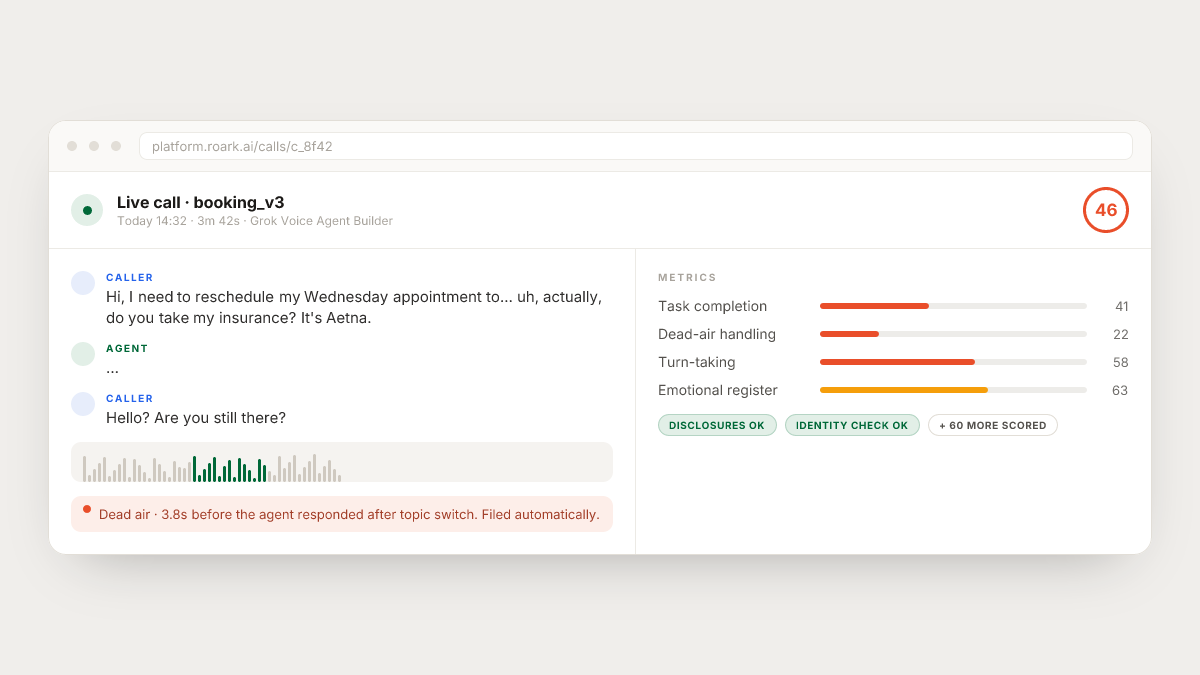
This is the argument for audio-native evaluation, and it is the argument that gets stronger, not weaker, as the models get better. When a model can hold a fluent conversation, the remaining failures are the ones a transcript cannot see: a subtle uptick in vocal stress that says the caller is losing patience, a 3.8-second pause that says the agent got confused, the wrong pronunciation of a drug name that says the agent is not safe to launch in healthcare.
The pre-launch checklist that scales with the new speed
If your engineering team is not going to be in the loop on every change, the testing has to be. The following is what a functioning pre-launch pass looks like when the build is measured in minutes.
- A persona set that reflects your actual callers. Not three demo personas. Twenty to fifty, covering the accents, languages, speech paces, and background environments your production traffic contains. If you serve US home services, that includes a caller in a truck cab with a leaf blower in the background. If you serve healthcare, it includes callers with a medication in their mouth.
- A scenario library that includes the boring paths and the ones that hurt. Happy-path booking is table stakes. What breaks is the interrupt, the mid-call topic switch, the caller who gives their date of birth wrong the first time, the caller who asks a policy question you did not put in the knowledge base.
- Real telephony in the loop. An agent that passes on a WebSocket in-browser test can still fail on the PSTN path. Jitter, packet loss, codec transcoding, and the specific way barge-in interacts with your carrier all live outside the browser. If your test does not go over a phone line, it is not a phone test.
- Metric thresholds that would actually block a launch. "Sounds good" is not a threshold. Task completion above X, latency to first token below Y, dead-air incidents below Z, PII disclosure incidents at zero. Write them down. Fail the launch when they are not met.
- Regression tests built from real failures. Every production call that fails a metric becomes a scenario that runs on every future version. Otherwise you fix the same bug three times.
- Automated runs on a schedule, not on a whim. If a test has to be triggered by a person, it will not run the week you ship the risky change. Nightly, on-commit, or on-deploy: pick one and make it non-negotiable.
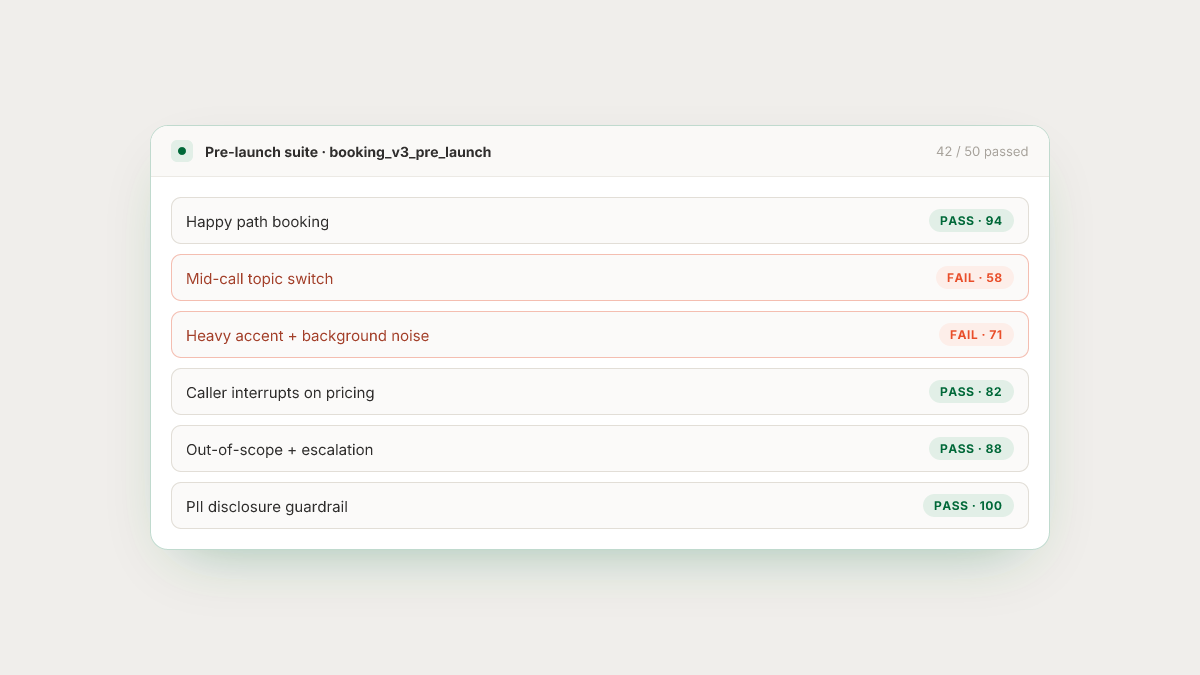
None of this is novel if you have shipped voice before. What is novel is the tempo. When Retell's own team is shipping agent edits in 90 seconds, the QA layer has to keep up, and the only thing that keeps up with that tempo is automation that runs on every change.
Where Roark fits
Roark is a simulation-testing, observability, and reporting platform built for exactly this shift. The core is simulation: we dial your agent over real phone calls, PSTN or WebRTC, using personas that define voice, language, accent, pace, emotional register, and the background-noise environment. Runs are recurring and automated, so a suite that took a person a day now runs on every deploy. We simulate and score in 45 languages and accents.
Every live call is scored against the same metric suite, so the audit trail is continuous. The scoring is audio-native: pronunciation, emotion, vocal stress, pace and pauses, and interruptions, all measured on the sound of the call rather than the transcript. What breaks is filed as an issue automatically. When it is a real production failure, you can replay that call against updated agent logic and keep it as a regression test forever, so the same class of failure never ships twice.
Roark has one-click integrations for Vapi, Retell, LiveKit, Pipecat, Bland, and ElevenLabs, so whichever platform you used to build your two-minute agent, the testing wraps around it. For regulated verticals there is a HIPAA BAA and SOC 2 Type II certification. For the CI part of the pipeline there is a Node SDK, a Python SDK, and OpenTelemetry traces for every call.
The point is not that testing is a nice thing to add on. The point is that when the build takes two minutes, testing is the only thing that separates a voice agent that ships from a voice agent that stays shipped.
The bet worth making
Every builder platform this quarter is telling you the same thing: shipping a voice agent has never been easier. They are right. What none of them are telling you, because it is not their job, is that the ease of shipping has moved the risk. The next voice-AI failure that makes a headline will not be a failure to launch. It will be a failure to notice.
If you are running voice-agent QA in a company that ships this quarter, the question to bring to your next planning meeting is not "which builder should we use." It is "what does our test suite look like when a non-engineer can change the agent in 90 seconds, and how do we know before the customer does?"
Build fast. Test faster.