In the last two weeks, three announcements quietly moved the goalposts for voice AI. On June 29, Retell shipped Conductor, a natural-language copilot that builds and edits production voice agents inside their own workflow graph. On July 1, xAI launched Voice Agent Builder, a no-code platform that bundles telephony, retrieval, tool-calling, guardrails, and observability behind a plain-language description of the call flow. On July 8, OpenAI released new voice models tuned for longer, more natural live conversations, with silence-tolerant context handling.
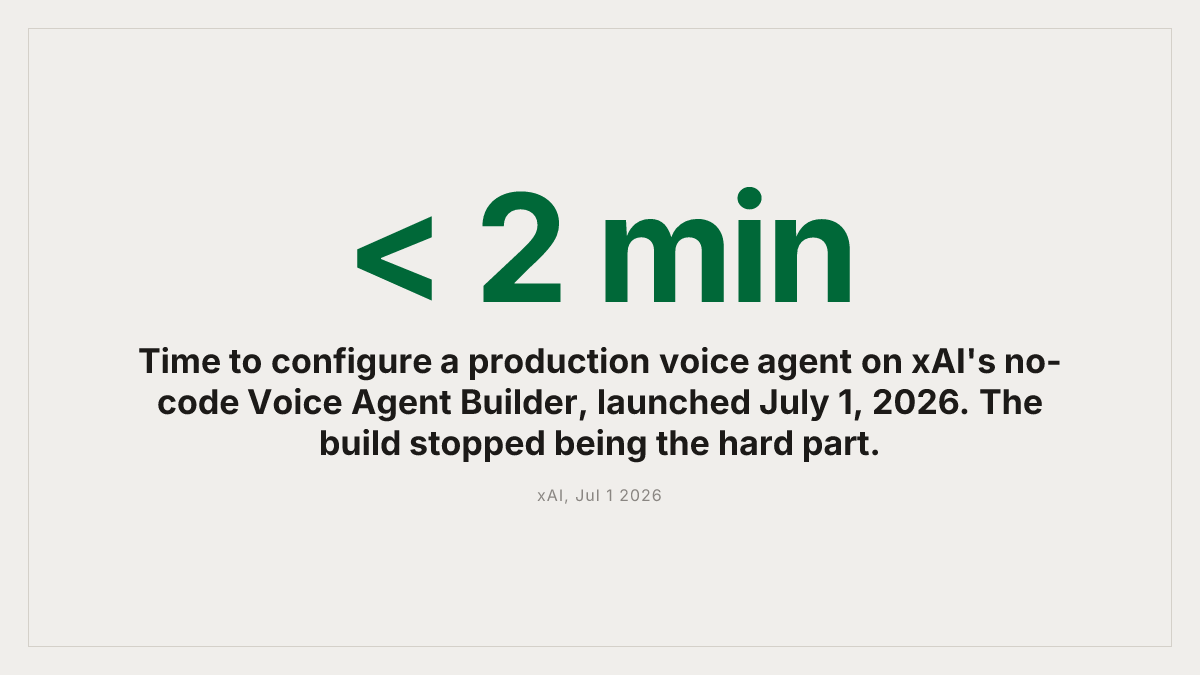
You can now stand up a production-shaped voice agent in the time it takes to make coffee. That is the good news. The bad news, if you are the product leader accountable for the launch, is that the hard part of shipping a voice agent has moved. It is no longer "can we build one?" It is "how do we know this one is actually safe to put on a real customer's phone?"
The commodity is the build, not the behavior
xAI is explicit about the pitch: it targets "operators and developers who want high-volume production voice agents without building the surrounding stack from scratch," with a promise of under two minutes from prompt to phone number. Retell's Conductor makes similar claims, generating about 70% of Retell's own internal simulation tests and executing half of the edits their engineering team ships. OpenAI's new mode is designed for conversations that run for 30 or 40 minutes without losing thread.
Read those three together and the direction is unmissable. Model quality is converging. Configuration is a UI job. The pieces that used to eat weeks (telephony wiring, guardrails, knowledge retrieval, call review) are becoming table stakes in the builder itself. If your differentiator was "we have a voice agent that works," it just evaporated.
The Forbes Technology Council made the same point from a different angle last week. In an op-ed on why AI voice agents underperform in outbound outreach, the argument is that failures rarely trace back to weak language models. They trace back to operational gaps: persistence, scheduling, brittle handoffs, edge cases the model was never shown. The model is not the bottleneck. The system around it is.
What "launch-ready" now means
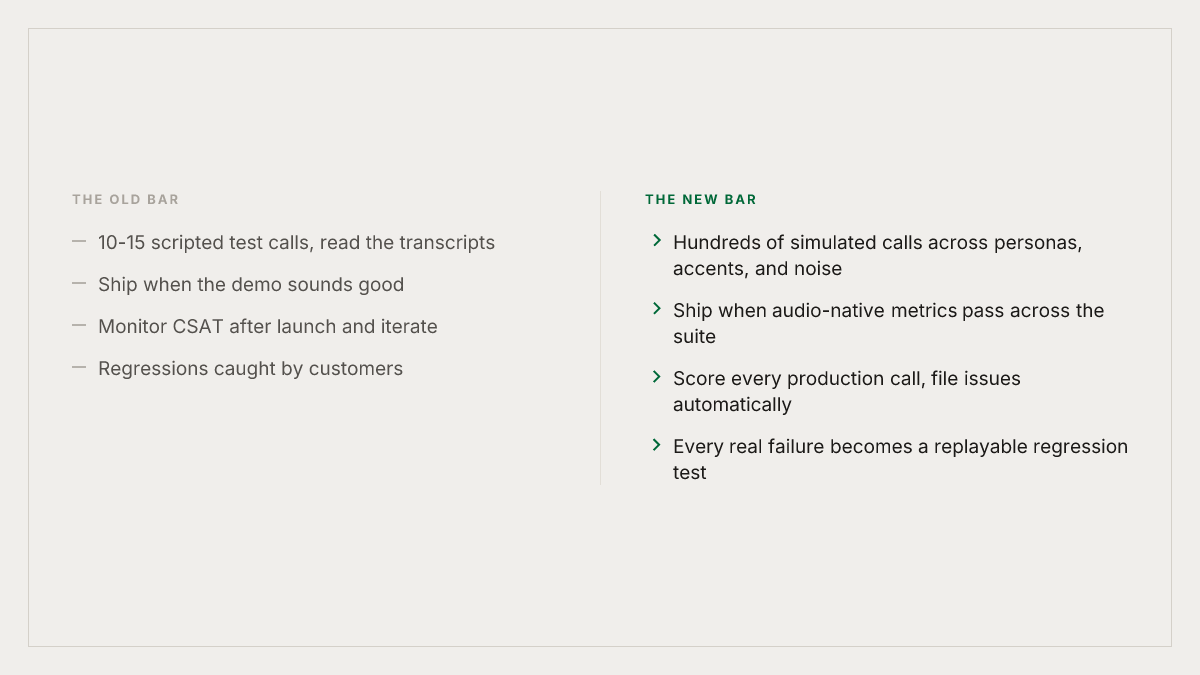
For the last two years, most teams treated a voice-agent launch the way they treat a chatbot launch: write some scripts, dial the number a dozen times, listen for anything embarrassing, ship. That worked when nobody had one. It does not work when the builder your competitor uses will spin up an equivalent agent tomorrow afternoon.
A practical release checklist making the rounds this month puts it plainly: most demos sound fine in a five-minute walkthrough, and production is a different animal the moment a real caller interrupts, gives partial information, changes their mind, or asks the agent to do something outside policy. Bland's engineering team, writing on the same topic a few days ago, was blunter: a handful of passing scripted calls is a signal of optimism, not readiness. They point to a working baseline of 50 to 100 representative conversations covering intents, accents, interruption patterns, and ambiguous phrasing before you should trust the agent with real callers.
That is the floor. What separates the teams that will win from the teams that will keep re-launching in embarrassment is how they built that suite, what they measure, and what happens when a real call goes wrong.
The failure modes that never show up in a transcript
If you evaluate your agent by reading transcripts, you will keep missing the failures that actually cost you customers. A voice call is not text. A production readiness checklist from earlier this year walks through eleven stress tests that all live below the transcript layer: background noise, interruption management, silence handling, low-bandwidth networks, session recovery after a drop, failover when a component times out.
Every one of those is invisible in text. A transcript will happily show you a clean "How can I help you today?" from the agent and a clean "I want to reschedule my appointment" from the caller. What it will not show you is that the agent stepped on the caller's third word, or that it left 3.8 seconds of dead air before responding, or that its pronunciation of the medication name was close enough to a different medication to be dangerous. The Infobip launch docs hammer the same point from the build side: voice output has to be tested against voice-formatting rules, not against how the response looks on a screen.
The short list of things a PM needs their team to have measured before launch:
- Barge-in behavior. Can the agent stop talking when the caller interrupts? Does it process what the caller said, or does it keep pushing its previous response?
- Silence and pause handling. Does the agent wait for a thinking caller, or does it plow ahead? Does it recover if the caller goes quiet for ten seconds?
- Noise robustness. Does recognition survive a busy office, a car, a coffee shop? At what point does WER degrade past the point where the agent starts guessing?
- Emotional register. Does the agent's tone stay appropriate when the caller is frustrated? Does its pace change, or does it read like a hostage note?
- Handoff cleanliness. When the agent decides to transfer, does the human on the other side get the context, or start from scratch?
- Policy boundaries. When a caller asks for something outside scope, does the agent refuse cleanly, or does it improvise a policy?
None of these are new. What is new is that every builder in the market can now produce an agent that passes a superficial demo of all of them. So the standard has to rise. You cannot spot-check any of these anymore. You have to test all of them, at volume, before every release.
Simulation before launch, scoring after
The discipline that closes the gap is straightforward, even if the tooling has taken a while to catch up. It has two halves, and they only work together.
The first half is pre-launch simulation. Real synthetic callers, real audio, real telephony, running through your agent's actual endpoint. Not text loopback, not "graded by an LLM reading a script," but calls that dial in, speak, listen, interrupt, and hang up. You build a suite of scenarios that cover your top intents plus the failure modes above, you assign personas (accents, pace, background noise, emotional state), and you run the whole suite on every material change.
This is where Roark's simulation testing lives. Roark dials your agent over real PSTN and WebRTC, with personas covering languages, accents, speech pace, emotional register, and background environments across 45 languages. It runs on a schedule, it triggers over HTTP so you can gate CI on it, and it scores every call against 64+ built-in audio-native metrics plus whatever custom metrics your business demands. If your suite starts passing consistently, you have earned the right to launch. If it does not, you have a concrete list of things to fix instead of a vague "sounds off."
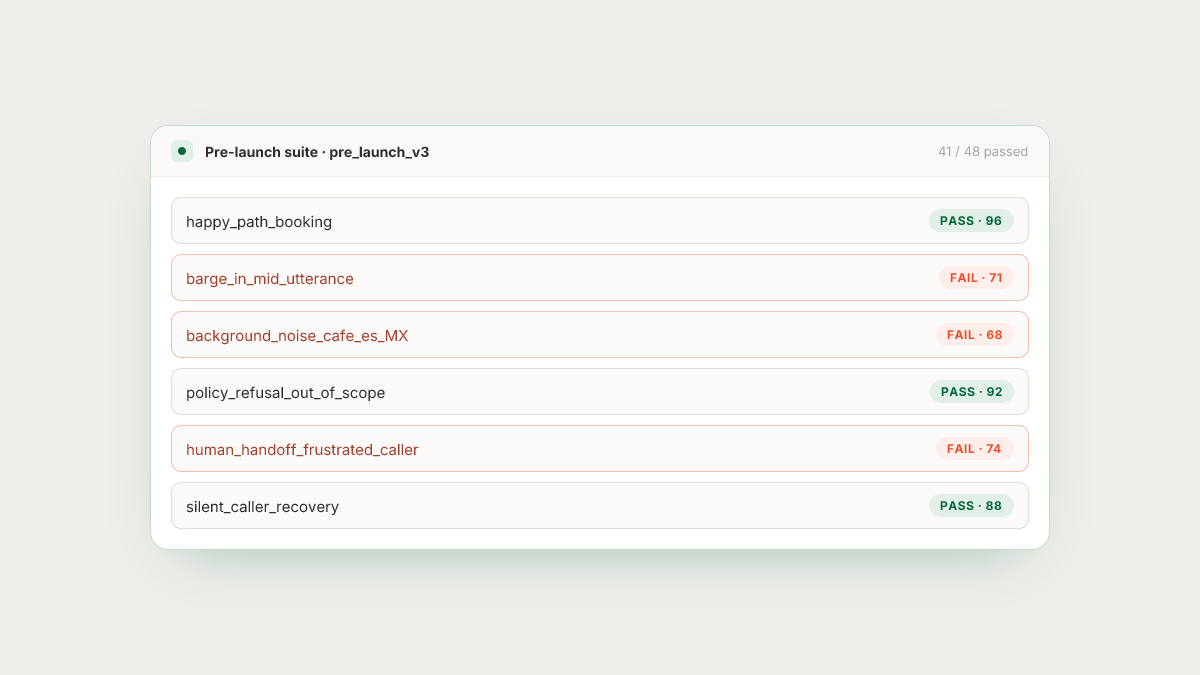
The second half is live scoring after launch. Every real call, scored against the same metrics you used pre-launch, with issues filed automatically when something breaks. This is where transcript-only tools give up. Audio-native scoring picks up pronunciation drift, dead air, interruptions, stress in the caller's voice, pace problems, the whole surface that a transcript flattens away. When a call fails a metric, you want an issue filed and a link back to the exact clip, not a chart that says the aggregate got worse this week.
The other reason to score live traffic on the same axes as your pre-launch suite is that it lets you close the loop. Every failed production call becomes a candidate regression test. Roark's production call replay captures the real audio and replays it against your updated agent logic, so a failure you saw on Monday is a fixed test case by Friday. That is the loop the release-checklist authors keep pointing at when they say every production failure should become a permanent test case.
What this changes for the PM
If you own a voice-agent launch, three things shift in the next quarter.
Your gate has to be a suite, not a demo. "It sounded good when I called it" is now a description of the market, not a signal of readiness. Every material change to prompt, tool, model, or vendor needs a full simulation run before rollout, with pass thresholds you agreed on before you saw the results.
Your metrics have to be audio-native. Transcript metrics will let you ship an agent that talks over its callers, mispronounces the customer's name, and leaves dead air after every tool call. The metrics that matter (interruption rate, dead-air duration, pronunciation accuracy on your entities, emotional appropriateness, pace) live in the audio. Pick a toolchain that scores the sound, not the transcript.
Your regression suite has to be alive. The suite you launched with will decay. New failure modes will show up in production the day a model provider quietly ships an update. If your team is not converting real failed calls into replayable tests every week, your coverage is drifting downward whether you can see it or not.
The two-minute agent is a real thing now. It is not a threat, it is a permission slip. The teams that will end up owning categories are the ones that treat the freed-up build time as budget to spend on rigor: more scenarios, more personas, more languages, more audio-native metrics, more real failures turned into tests. The build stopped being the hard part. What you do with the time you got back is the launch.