On August 13, a federal judge in the Northern District of California refused to dismiss the central privacy claims against Otter.AI, letting the case proceed under federal wiretap law, California's Invasion of Privacy Act, and Illinois's Biometric Information Privacy Act. The reasoning matters more than the defendant. The court held that Otter is a third-party eavesdropper under CIPA section 631 because it independently collects, retains, and uses call content for its own commercial purposes, not just because it transcribed something.
That logic does not stop at meeting notetakers. Any voice AI product that records callers, stores audio, and reuses it for QA, evaluation, or model training is on the same terrain. Recording consent is now a testable regression, and the teams shipping voice agents into production need a QA program that treats it that way.
Recording consent is not AI disclosure, and it is not TCPA
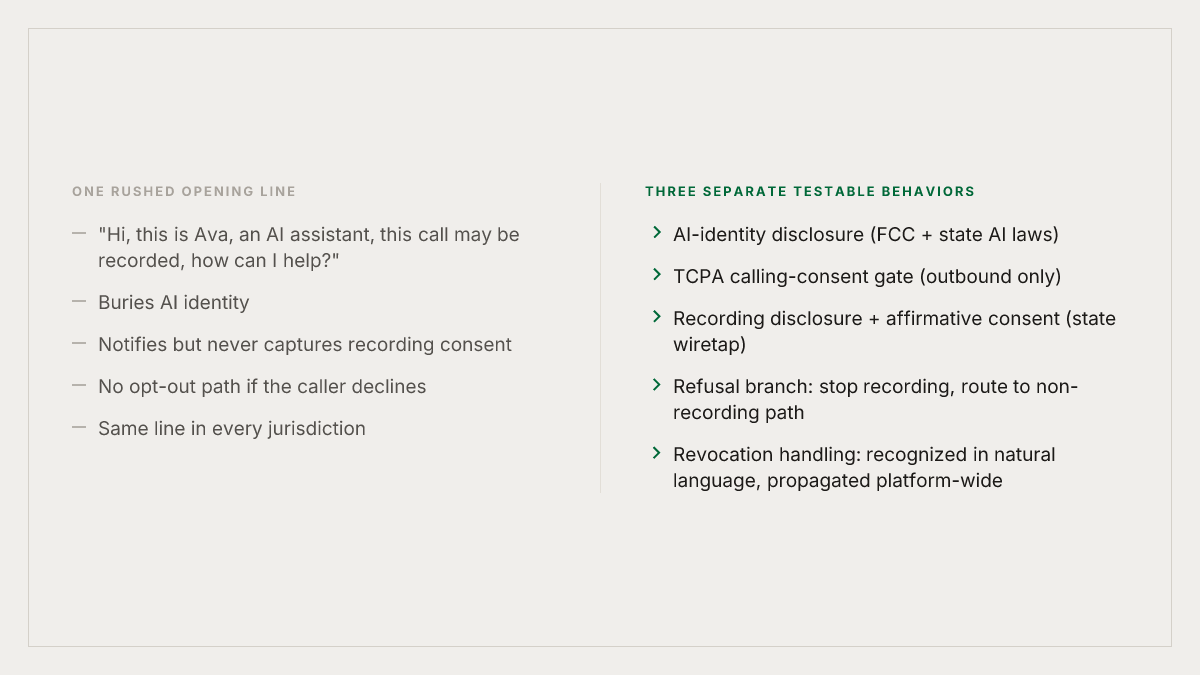
Voice AI compliance conversations tend to collapse three separate legal duties into one opening line. They are not the same.
The FCC's February 2024 Declaratory Ruling confirmed that AI-generated voices fall within the TCPA's definition of "artificial or prerecorded voice." That governs whether you can place the call and requires prior express consent, identification, and opt-out rights for outbound AI-voice calls. It is calling-side law.
Recording is a different question governed by a patchwork of state one-party and two-party consent statutes that has to be checked independently of TCPA. Thirteen states, including California, Illinois, Florida, Massachusetts, Maryland, Pennsylvania, and Washington, require all parties to be informed and agree before a conversation can be recorded. California Penal Code 632 covers any "confidential communication," which post-Otter includes call audio that a vendor may reuse for model training.
And AI identity disclosure is a third obligation entirely. States like California under AB 2905 require that a caller be told they are talking to an AI, regardless of whether recording is happening.
Three duties, three bodies of law, three separate testable behaviors. Your agent's opening turn has to satisfy all three, and satisfying one does not satisfy the others.
Where voice agents quietly fail this
The failure modes are not exotic. They show up in every voice agent QA engagement I have seen, and none of them require the caller to try to break the agent.
The disclosure never plays. A model swap or a prompt refactor drops the recording notice from the opening turn. The change ships because the happy-path calls sound fine, and nobody's dashboard is watching for a missing sentence.
The disclosure plays but no consent is captured. The agent says "this call may be recorded" and moves on. In a two-party state, notification without agreement is not consent, and staying on the line does not count.
The "no" case is untested. When a caller says "please don't record this," most agents either ignore it, apologize and continue recording anyway, or hallucinate a policy ("I have to record for security"). Almost none actually stop the recording, delete the segment, or route to a non-recording path. That is the branch that produces class-action complaints.
Mid-call revocation is silently dropped. A caller two minutes in says "actually, I don't want this recorded." A conversational AI has to recognize revocation in natural language, not through a keyword-based opt-out, and that revocation has to propagate platform-wide, not just end the current session.
Warm transfer inherits nothing. The agent captured consent, then handed off to a human. Does the human agent's console show the consent state? Does the recording continue automatically, or does it need to be re-authorized? Most warm-transfer implementations we look at simply keep recording without ever telling the human the caller's consent posture.
Vendor retention is the silent liability. Even if your agent handles all of this correctly, if your platform contract gives a vendor the right to reuse call content for training or improvement, the Otter analysis suggests you may already have a problem regardless of what your disclosure said. That is a procurement question, not a QA question, but QA is where it will get discovered.
Why sample-based review misses the ones that matter
Recording-consent behavior looks perfect on 95% of calls, because 95% of callers say nothing about it. The failures live in the tails: the caller who objects, the caller who asks a clarifying question ("recorded by whom?"), the caller who consents and then revokes, the caller who is transferred to a supervisor twenty minutes in. Random sampling will not find these at any useful rate, and by the time you spot one in a QA review, it has already happened at scale.
The compounding is the problem. A single call that ignored a consent refusal is a bug. A prompt regression that shipped Monday and processed 4,000 calls before someone noticed on Friday is statutory damages of $500 per violation, trebled to $1,500 for willful violations, across every one of those calls. Voice agents ship as often as multiple times a week, and the "we caught it in review" reflex does not hold up when review is one call in a hundred.
Consent behavior is deterministic in the way that latency is not. There is a right answer for each of the branches above, it is scriptable, and you can grade it before any real caller is on the line. That is the case for testing it in simulation.
What the pre-launch simulation needs to cover
A recording-consent regression pack is not long. Every voice agent shipping into a two-party jurisdiction should be running these before every deploy:
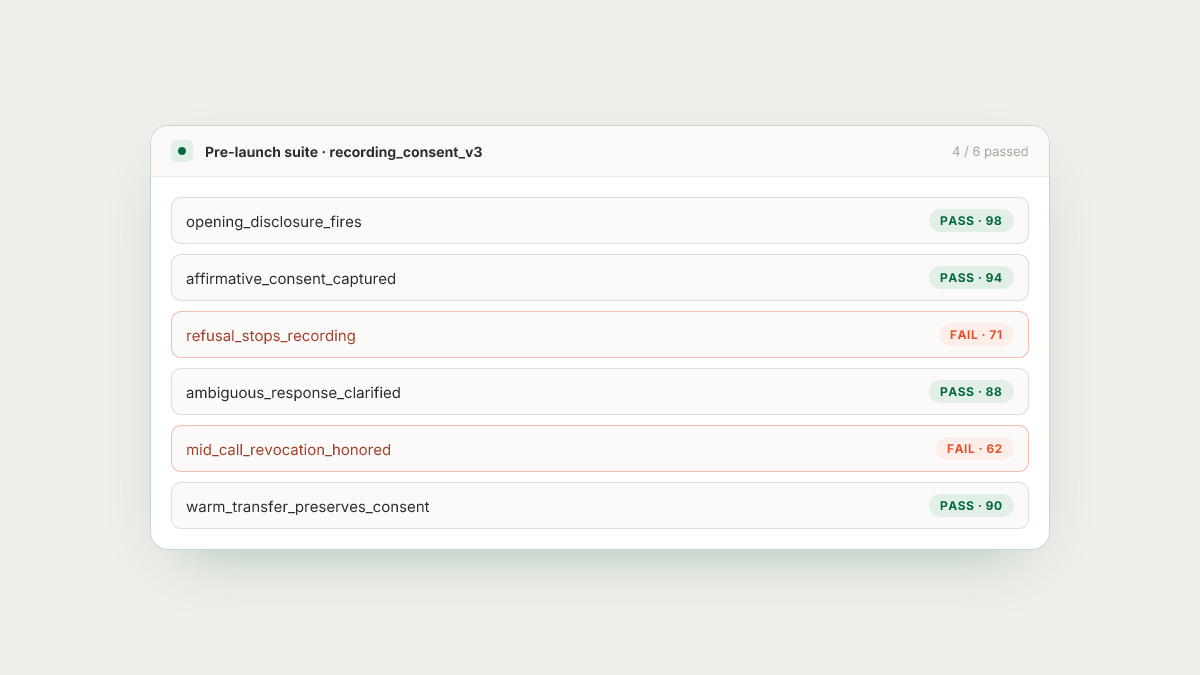
- Baseline disclosure fires on the first agent turn, before any substantive question.
- Explicit affirmative consent is captured and logged, not just notification.
- Refusal is honored. The agent stops recording, confirms the change, and completes the call on a non-recording path or offers a callback with a human. Transcript for the pre-refusal segment is treated per policy.
- Ambiguous responses trigger clarification. "What do you mean?" gets a plain-language explanation, not a re-read of the notice or a silent continuation.
- Mid-call revocation is recognized as natural language, applied to the live call, and propagated to future contact records for that phone number.
- Warm transfer preserves consent state. The human console shows the caller's recording posture. If consent was refused, the transfer path is a non-recording line.
- Multi-lingual coverage. If your agent handles Spanish or Mandarin callers, all six behaviors above are tested in each language, because a disclosure that plays only in English is not a disclosure to a Spanish-speaking caller.
Each of these is a persona and a scenario, not a legal question. Once you have them, they run on every prompt change, every model swap, every deploy.
This is exactly what Roark's simulation testing is built to do. Roark dials your agent over real telephony (PSTN or WebRTC) with personas that speak different languages, accents, and emotional registers, and runs those scenarios on a schedule or as a CI gate. Consent-refusal and revocation personas become part of your recurring pre-launch suite in the same way any other regression scenario does.
Scoring every live call, not just the ones you sample
Pre-launch simulation stops the obvious regressions. Live scoring catches the drift.
Every production call an agent handles can be graded against a set of consent-specific checks: did the disclosure play in the opening turn, was it audible above background, was affirmative consent captured, did the agent correctly handle a refusal or revocation if one occurred. These are audio-native evaluations, not transcript grep, because "this call is being recorded" spoken in a rushed monotone at the end of a greeting is legally different from the same words at the start, clearly articulated.
Roark scores every live call against your metric suite and files an issue when any of them fails. The missing-disclosure regression that made it through simulation does not sit in the tail for weeks. It shows up in the dashboard, tied to the exact call, timestamp, and prompt version, the first time it happens.
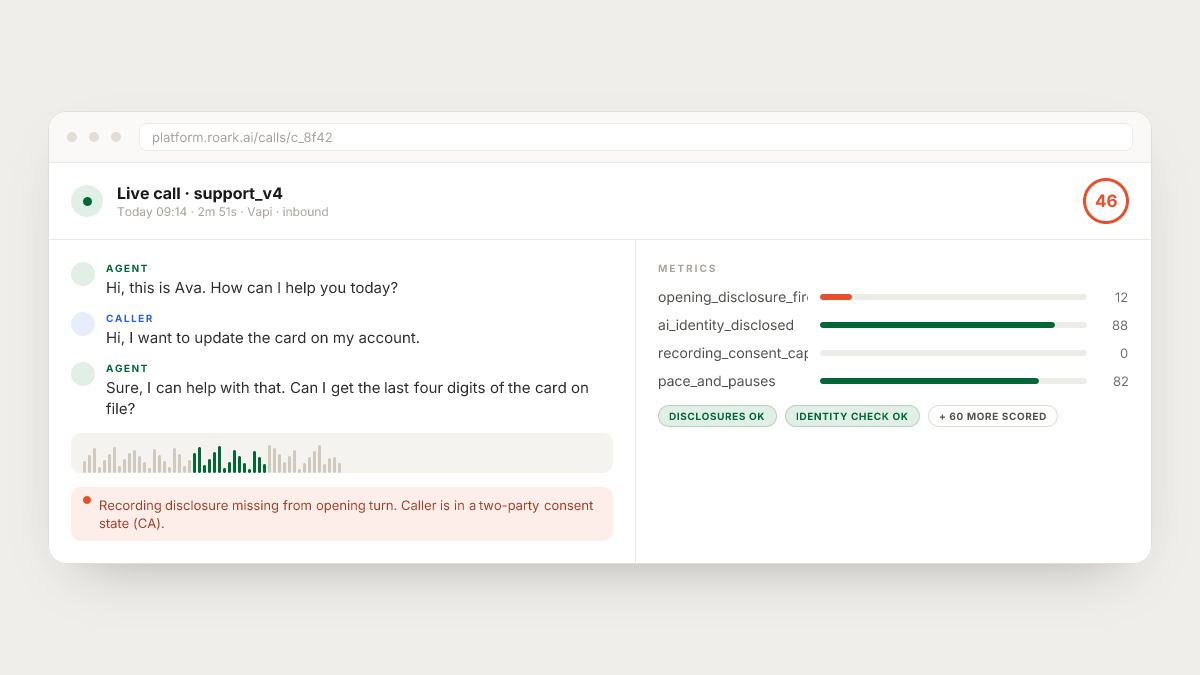
The same failures become the source recordings for the next round of testing. A production call where the agent mishandled a refusal is exactly the call you want in your regression pack. Roark's production call replay captures those calls and replays them against updated agent logic, so a real failure becomes a repeatable pre-launch test the moment it is diagnosed.
What to require from the QA program now
The Otter ruling did not change the underlying statutes. It sharpened the enforcement posture, and it made clear that vendor reuse of call content is where the plaintiffs' bar is aiming next. For voice AI teams the implications are practical:
- Treat the recording disclosure as a separate testable behavior from AI-identity disclosure and from TCPA calling consent. Three checks, not one.
- Test the "no" branches. If your simulation coverage only exercises callers who consent, you have not tested the branches that produce liability.
- Score every live call for the disclosure and for consent handling, not a 1% sample. This is the difference between finding one violation and finding four thousand.
- Write your vendor contracts as if the retention question will be litigated, because the Otter court's one question for meeting-assistant customers applies to voice AI platforms too: does the vendor retain and reuse customer conversation content for model training.
- Rehearse revocation and transfer paths at least as thoroughly as the greeting.
Compliance work usually lives in policy documents and hopes to be true in production. Recording consent does not have to. The behaviors are deterministic, the branches are enumerable, and simulation testing plus live scoring turn the whole thing into a regression pack that either passes or does not. Given where the case law is heading, that is the difference worth building for.
None of the above is legal advice, and your counsel should sign off on the specific disclosures and consent language for the jurisdictions you operate in. What we can help with is proving, on every deploy and every live call, that whatever they signed off on is actually what the agent does.