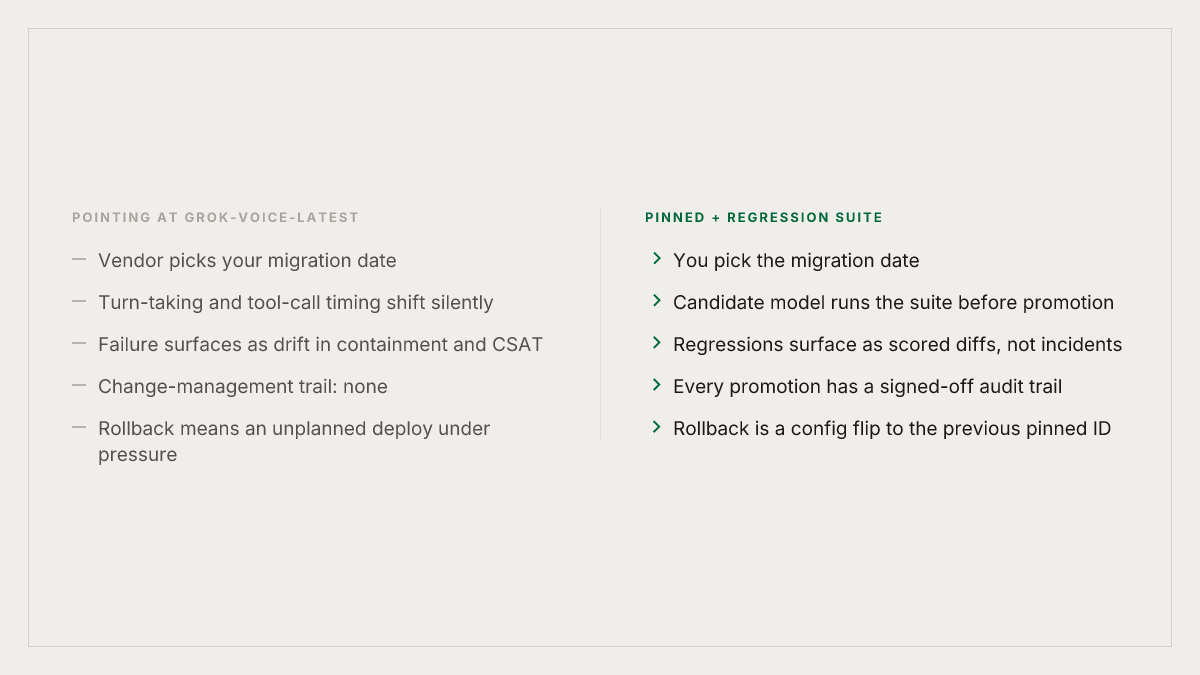
On August 5, xAI's grok-voice-latest alias flipped from Think Fast 1.0 to 2.0. If you had pinned a versioned model ID, nothing changed. If you were pointing at grok-voice-latest, your agent's brain got swapped mid-shift. Median reasoning-token use fell to about 0.4x the previous baseline, time to first audio dropped from 1.25s to 0.70s, and the model was retrained to speak in shorter sentences, ask one question at a time, and cut fluff. All of that is a shipped behavior change your users heard before your on-call did.
This isn't a Grok-specific problem. It's the shape of every voice model provider now: OpenAI's Realtime family, Gemini's Flash line, ElevenLabs Agents, Deepgram Nova, all of them rev underneath floating aliases. This post is the regression playbook we use with teams for that class of event: how to detect the roll, what to test, what to score, and how to gate promotion so the next silent migration doesn't leak into production traffic.
What actually changes when the model rolls
A voice model upgrade is not one change. It's a bundle, and most of the bundle isn't in the release notes. From the Think Fast 2.0 rollout alone, teams saw shifts in answer length, timing, turn-taking, tool-call frequency, clarifying questions, escalation behavior, transcription, pronunciation, and structured-data collection. Any one of those can turn a passing production flow into a broken one without triggering a single error log.
Concretely, the axes that move when a voice model rolls:
- Turn-taking. New endpointing behavior, new sensitivity to backchannels, new interpretation of silence. A model that used to wait 400ms before responding might now barge in at 180ms, or vice versa.
- Tool-call timing. xAI explicitly says 2.0 executes tool calls usually before the agent finishes its first sentence. If your webhook handler assumed the tool call would follow a full utterance, your ordering guarantees are gone.
- Sentence length and question shape. Reinforcement learning pushed 2.0 toward shorter sentences and one-question-at-a-time cadence. That's great for callers, catastrophic for any flow whose downstream parser assumed a single, dense confirmation utterance.
- Refusal and escalation thresholds. Post-training changes the model's willingness to answer questions it used to answer, and its trigger points for handoff.
- Transcription and pronunciation. The STT layer moved. Numbers, proper nouns, medication names, and account IDs are now recognized and spoken differently.
- Prompt sensitivity. xAI's own migration guidance is to shorten system prompts and drop old workaround instructions, because those workarounds were tuned against 1.0's failure modes. The scaffolding you built to compensate for the old model can now actively degrade the new one.
None of these show up as an incident. They show up as slow drift in containment, in call length, in escalation rate, in customer satisfaction. By the time your dashboards catch it, you've run a week of the new model's behavior against real callers.
Why the "just let it upgrade" default is the wrong default
The pitch from vendors is that migrations are low-friction: xAI expects Think Fast 2.0 to raise performance across almost all use cases without prompt changes. That's often true in aggregate. It is almost never true for every scenario in your suite.
Aggregate wins mask specific losses. A model that scores higher on the Artificial Analysis speech-to-speech leaderboard (82.9% vs 75.7% for the previous version) can still regress on your specific verticals: your Spanish callers, your noisy-line cohort, your medication-name pronunciations, your handoff triggers. Public benchmarks are directional. Your regression suite is the acceptance test.
There's also a change-management problem. If you operate under HIPAA, PCI, or any framework that expects documented change control for production systems, an unannounced model swap by a vendor is not a change you approved. Pinning a versioned model ID and running a scored migration suite is what turns that vendor decision back into your decision.
The pin-then-test pattern
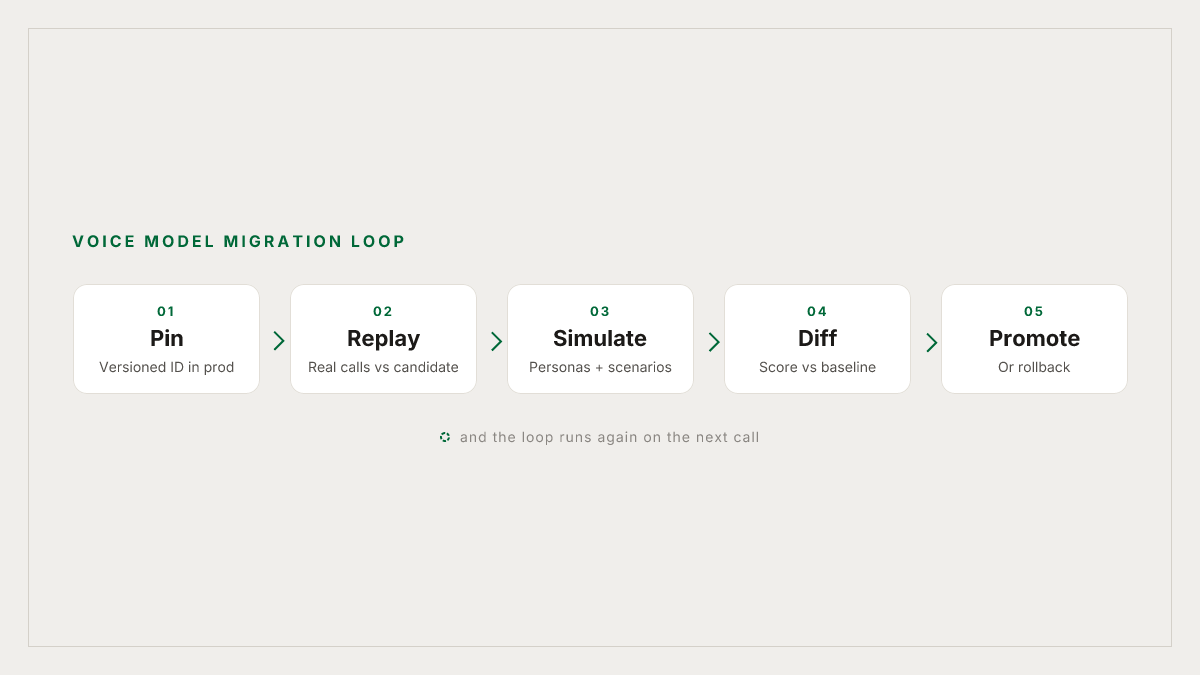
The mechanics are the same regardless of vendor. There are five steps, and skipping any of them is how teams end up debugging live callers.
1. Pin the current version everywhere. The production rule is simple: production points at a versioned ID (grok-voice-think-fast-1.0), never at grok-voice-latest or gpt-realtime-latest or any equivalent alias. Aliases are allowed in staging, where a silent roll is a signal, not an outage. This step alone would have saved every team that got surprised on August 5.
2. Freeze a baseline. Before you switch anything, record the current pinned model's scores on your regression suite: task completion, tool-call correctness, turn-taking, latency, escalation rate, transcription accuracy on your accents, and whatever custom checks you care about per vertical. This is the "before" you'll compare against.
3. Replay production traffic against the candidate. Real calls from the last two to four weeks are your best test set, because they contain the accents, background noise, interruptions, and off-script detours your synthetic suite doesn't. Replay them against the candidate model and score.
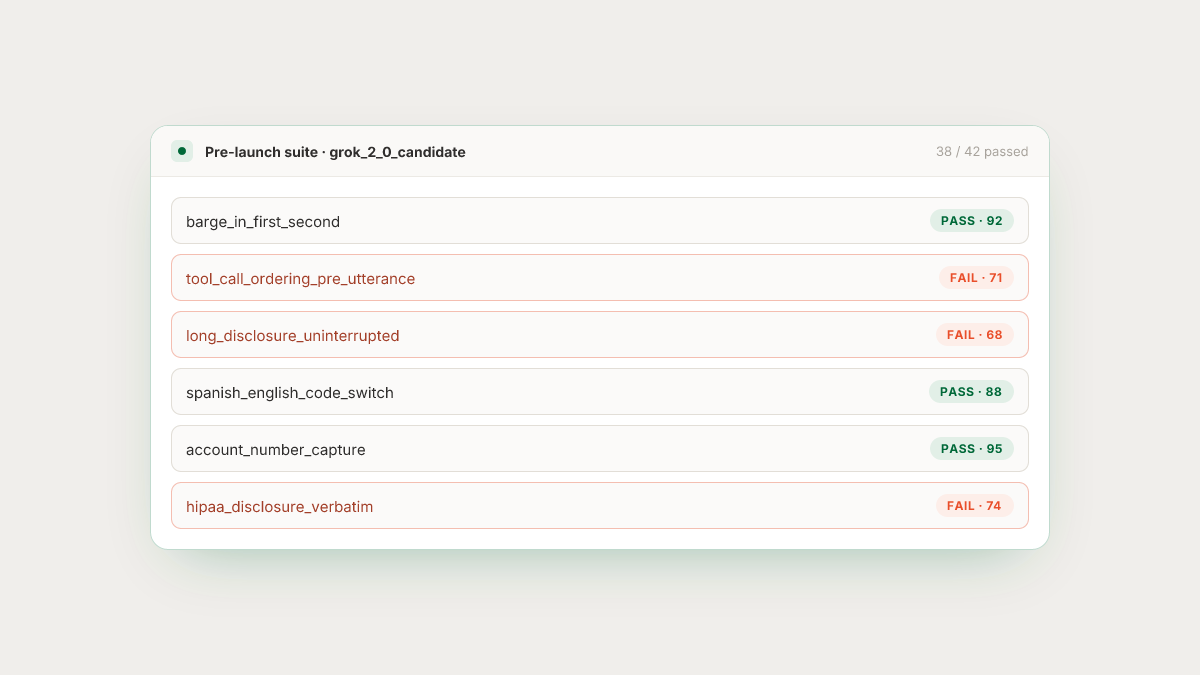
4. Add fresh simulations for the failure modes the release notes hint at. If the vendor says tool calls now fire before the first sentence ends, write scenarios where the caller barges in during that first sentence. If the model was retrained for shorter sentences, write scenarios where the caller says "no wait, tell me everything at once" and score whether the agent still gets the required disclosures in.
5. Diff, decide, promote or rollback. Compare candidate to baseline per metric, per cohort. Aggregate wins with specific regressions are the common case, and the interesting question is whether the regressions are in cohorts you can afford. If they aren't, you either fix your prompt against the new model and re-run, or you stay pinned to the old version until you can.
Building the migration suite
The suite has three layers. Each catches different failures, and skipping any one leaves a class of regression unprotected.
Layer 1: production replay
Capture real production calls, feed them back into the candidate model, and score. This is where you catch the long tail: the caller who mixed Spanish and English, the one with a screaming toddler in the background, the one who said "cuatro" when your agent expected the digit 4. No synthetic suite of any size covers that distribution as well as your own last-fortnight of traffic does.
Two constraints matter here. First, replay has to be over the real transport — telephony audio, not a text transcript loopback — because half of what changed between model versions is audio-native. Second, you need to score the replay on the same audio-native metrics you use in production: not just did the transcript match, but was the response in time, did the model interrupt the caller, was the tone right.
Layer 2: persona-based simulation
Personas cover cohorts you may not have enough production traffic for yet: a specific accent, a specific age range, a specific emotional register, a specific noise environment. For a Grok 2.0-style migration, high-value personas are the ones that most exercise the changed axes:
- A caller who speaks over the agent within the first second, to test the new endpointing.
- A caller whose account number the previous ASR got right but that a retrained ASR might mishandle.
- A caller who asks a compliance-sensitive question the previous model refused and the new one may not.
- A caller who requires the agent to deliver a long disclosure the new "shorter sentences" model may want to compress.
Layer 3: scenario regressions
The most valuable tests you have are the failures you already fixed. Every prompt change, every guardrail patch, every escalation rule you added was in response to a specific failure. Codify each one as a scenario in the suite. Then when the model rolls, you check that all the failures you paid to fix are still fixed.
What to score, not just what to check
Pass/fail is not enough for a migration. Voice output is probabilistic, and "the agent completed the task" hides most of what changed. Score on a spectrum, and score audio-native.
The metrics that matter for a model migration, roughly in order of what breaks first:
- Time to first audio and response latency. Directly moves with the model. If your target was p95 under 1.2s, verify it against the candidate on your telephony path, not the vendor's synthetic benchmark.
- Interruption and barge-in behavior. Did the new model start speaking over callers who used to get uninterrupted turns? Did it stop yielding when it should?
- Tool-call correctness and ordering. Right tool, right parameters, in the right sequence relative to the utterance.
- Task completion by intent. Sliced by the intents that actually make you money. Aggregate task completion can rise while your two most important intents quietly regress.
- Compliance and disclosure checks. AI disclosure, HIPAA safe-harbor language, regulated scripts, warm-transfer triggers. These are pass/fail and any regression is a launch-blocker.
- Pronunciation and transcription accuracy on your vocabulary. Especially for numbers, dates, proper nouns, medications, and account IDs.
- Sentiment, pace, and stress in the model's voice. If the new model sounds rushed or flat on a persona where the old one didn't, callers will feel it long before your CSAT drops.
Score every candidate call on every metric, per cohort. Then the diff against baseline is a table you can defend to your compliance officer, your product lead, and your board.
Gating CI on the diff
Once the suite exists, the migration playbook collapses into two rules:
- Every voice model or prompt change runs the suite before it merges. Any candidate that regresses on a launch-blocker metric fails the build.
latestaliases in staging fire the suite on every observed model roll. When the vendor bumpsgrok-voice-latestorgpt-realtime-latest, staging notices, the suite runs automatically, and the diff shows up in Slack before anyone has a customer complaint.
This is the same discipline software engineering learned decades ago for library upgrades. The only difference is that the "library" is a probabilistic voice model, and the "test suite" has to be real phone calls scored on audio behavior, not unit tests scored on string equality.
Where Roark fits
Everything above is what Roark exists to make routine. Roark dials your agent over real telephony and WebRTC, drives conversations through configurable personas across voices, accents, languages, pace, emotional register, and background-noise environments, and scores every call on 64+ built-in audio-native metrics plus any custom checks you define. Model migrations are the canonical use case: pin production, point staging at the candidate, run the suite over HTTP so CI can gate on it, and diff the scores.
The piece specific to migrations is production replay. Roark captures real production calls and replays them against updated agent logic, which for a model roll means running your last two weeks of real traffic against the candidate before you promote. What breaks is filed as an issue automatically, with the audio, the transcript, the metric scores, and the OpenTelemetry trace.
When the next silent migration happens, and it will happen, the process is the same as any other change: pin, replay, simulate, diff, promote. The only teams that get surprised are the ones still pointing production at latest.
The next roll is already scheduled
Grok's rollover was announced. Most rolls aren't. Vendor model versions change without changing the version string as often as they change with one, especially inside a hosted platform where the "model" you configured is actually a bundle of pre-processing, an LLM, and post-processing that any of the vendors can revise independently.
The defense is the same either way. Pin what production points at. Keep a suite of real calls plus scored simulations that exercise the axes a voice model can move. Run it on every candidate, gate CI on the diff, and treat the vendor's promise of "no prompt changes required" as a hypothesis your suite is going to test.
Voice agents are systems, not models. Ship them like systems.