Something shifted in voice AI over the last two weeks. ElevenLabs opened its Marketplace of partner-built vertical voice agents on November 11, covering healthcare, financial services, insurance, education, retail, and government, with launch partners including Salesforce, IBM, NiCE, Twilio, and Zendesk. Convoso made its no-code Voice AI Agent generally available on November 2. Twilio shipped eight new voice AI features on November 17 aimed squarely at teams "moving voice agents beyond pilots." The direction of travel is clear: buy a finished vertical agent, not build one.
That shift is good for enterprises that would rather not reinvent appointment scheduling or lead qualification from scratch. It is also where a predictable category of outages is about to start. Because a marketplace agent, however well-tuned to an industry, is not tuned to your callers, your telephony, your tools, or your edge cases. The work the marketplace saves you is the configuration work. The work it does not save you is QA, and buyers keep assuming it does.
What the marketplace actually ships
The ElevenLabs Marketplace is framed as a way for enterprises to find and adopt agents already customized to their industry workflows rather than build from scratch. Assort Health, one of the featured partners, automates appointment scheduling and inbound patient calls and advertises specialty-trained scheduling logic with real-time EHR write-back. Consio handles order status, support, and abandoned carts for Shopify brands in 70 languages. These are real products with real customers, not demos.
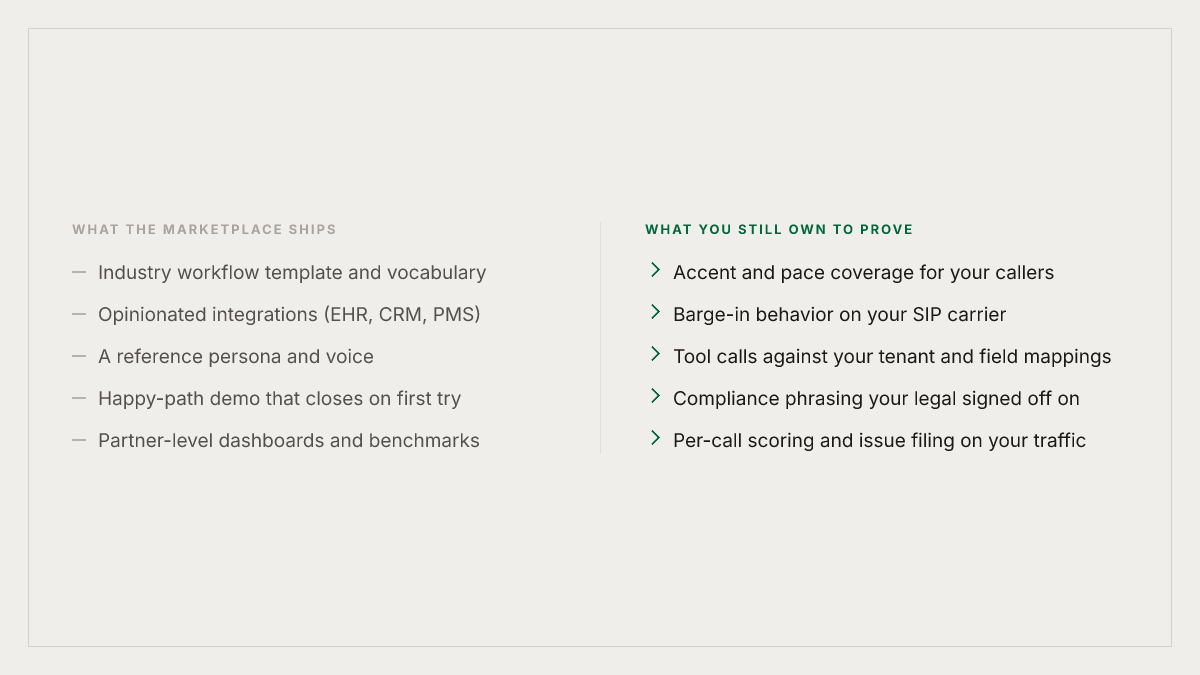
What those listings ship is a workflow template:
- Industry vocabulary the agent is trained to recognize and produce
- A reference call flow (intake, triage, scheduling, confirmation)
- Opinionated integrations (an EHR for a scheduling agent, a CRM for a sales agent)
- A voice, a persona, some default compliance language
- A happy-path demo that will close an appointment or qualify a lead on the first try
That is genuinely useful. It compresses months of prompt engineering, flow design, and tool wiring into a few configuration screens. If you are a mid-sized specialty practice or a regional retailer, buying it and plugging it in beats hiring a team of prompt engineers.
But the demo is not your production. Your production has callers your partner has never met, on a telephony stack your partner does not own, calling about edge cases that never surfaced in the training distribution.
Vertical fit is not acoustic fit
A marketplace agent has been tuned on the kinds of conversations the partner has seen a lot of. For Assort Health, that is a very large corpus of patient scheduling calls, enough that they can route by sub-specialty, check insurance eligibility live, and write bookings to the EHR in real time. For Consio, it is e-commerce calls across many Shopify merchants.
Your callers are a slice of that distribution, not the whole thing. A few things that vary enough to break the demo:
- Accents and speech pace. A rheumatology practice in Houston and one in Boston do not have the same patient population. The agent that handles one at 95% accuracy can slip to 70% on the other because of accent, cadence, or filler-word density, and the metric to catch that is pronunciation and ASR confidence at the audio layer, not a transcript diff.
- Background environments. Patients call from parking lots, car cabins, kitchens with the dishwasher running, and open-plan offices. VAD and endpointing behavior that works in a quiet demo flips to premature cutoffs or dead air once you add real room noise.
- Emotional register. A patient calling to reschedule post-op after a bad night is not a happy-path caller. The agent that handles cheerful first-time bookings may not handle stressed, interrupting, apologetic, or angry callers in the same way.
- Telephony path. Your SIP carrier, your IVR, your hold music, the number of transfers before the agent picks up: all of it affects packet loss, codec negotiation, and jitter, and none of it is controlled by the marketplace partner. Twilio itself acknowledged this week that production voice agents fail on silence timers and speech provider disruptions in ways demos do not.
A marketplace agent is tuned to the industry. It is not yet tuned to the intersection of your callers, your acoustics, and your telephony. That intersection is where launches wobble.
The integrations the agent inherits are not yours
A scheduling agent that writes directly to Epic is not the same as a scheduling agent that writes directly to your Epic instance, with your custom appointment types, your payer rules, and your referral codes. Assort Health markets bidirectional, real-time integration with 37 EHR/PMS systems, which is impressive and still not a guarantee that the field mappings for your particular tenant are correct.
The common failure modes:
- The agent books, but writes to the wrong provider template because your practice uses an unusual visit-type naming scheme
- The agent collects insurance but does not trigger the prior-authorization check your workflow requires
- The agent transfers to a human, but the warm transfer drops context because the partner wires it one way and your call center expects another
- The agent handles a refill request successfully in staging but silently fails on production e-prescribe because of a credential scope the partner did not anticipate
Every one of these is a QA gap, not a vendor bug. The partner cannot test what they do not have access to. You can.
Five things that quietly break on launch
If you are about to deploy a marketplace voice agent into production, assume the following are untested until you prove otherwise:
- End-to-end tool calls on your tenant. Not the demo tenant. Your tenant, with your field names, your custom objects, your rate limits.
- Barge-in behavior on your telephony. The partner's smart turn detection, however good, interacts with your SIP carrier's audio path. Twilio's new Conversation Relay smart turn detection reached GA this month precisely because the demo-stage version was not production-reliable; your downstream agent inherits that calibration, not a fixed one.
- Multilingual coverage for your market. Assort Health advertises 37 languages for its scheduling agent. Supported is not tested. Test the ones your population actually speaks, with accents, code-switching, and the dialect quirks that matter.
- Compliance phrasing. HIPAA, TCPA, state consent requirements, and your specific legal review's preferred wording are not something the marketplace partner will ever perfectly guess. Scripts drift between what legal approved and what the agent actually says, and nobody notices until an auditor listens.
- Failure handoffs. When the agent cannot resolve a call, what happens? A warm transfer with context, a cold dump to an IVR, a dropped call, a callback promise the system cannot keep? This is the single most common failure-mode gap in marketplace deployments, and it is entirely inside your scope.
None of that is an argument against buying off a marketplace. It is an argument against assuming the marketplace did your QA.
The pre-launch testing you still own
The useful mental model: treat the marketplace agent as a vendor-supplied subsystem. You would not deploy a new billing engine into production without running it against your transaction patterns first. A voice agent is the same.
What that looks like before you cut over live traffic:
- Build a persona set that matches your callers. Not the partner's reference personas. Yours. Accents, speech pace, emotional register, background-noise environments drawn from the calls your human agents actually take today. Roark's simulation testing dials the agent over real phone calls (PSTN or WebRTC) from configurable personas, not a text loopback, so pronunciation, pacing, and barge-in behavior get exercised the way production will exercise them.
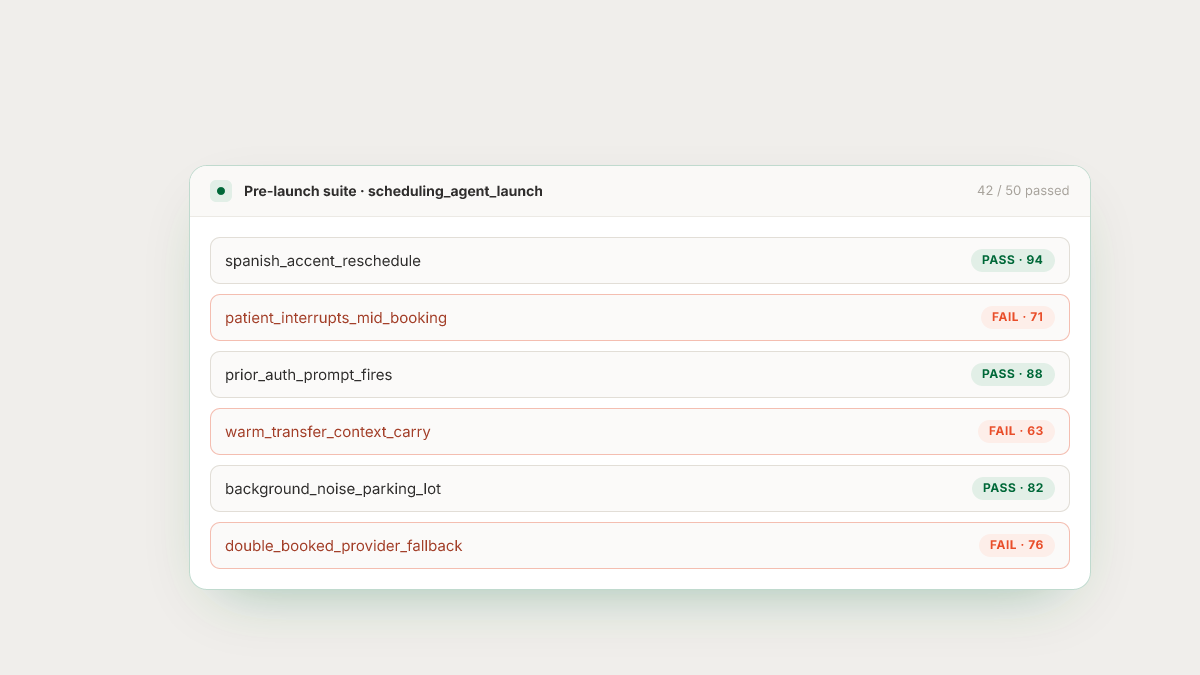
- Build scenarios for your edge cases, not the happy path. The partner's demo covers the happy path. Your suite should cover the double-booked-provider case, the unclear referral, the patient who interrupts to ask about insurance mid-booking, the caller who starts in Spanish then switches to English. Simulations are built from personas, scenarios, run plans, and schedules and can run on a recurring schedule, including on every change the partner ships upstream.
- Replay your real calls against the new agent. Before launch, you likely have hundreds or thousands of recordings from your current human-handled or legacy-IVR workflow. Replay them against the marketplace agent and score what breaks. Production call replay is the fastest way to find the edge cases that never make it into anyone's scenario spec.
- Score every live call once you cut over. Marketplace agents ship with marketplace dashboards, which tell you how the agent performs on average across the partner's whole customer base. You need per-call scoring on your calls, on audio-native metrics (interruptions, pace, emotion, pronunciation, not just transcript keywords), with automatic issue filing when a call fails a check. That is how you catch a slow regression on week three.
- Make simulation a gate on upstream updates. The partner will ship changes. New TTS voices, retrained STT, prompt tweaks, tool updates. Each of those is a voice-model refresh you did not schedule. Gate each one with a simulation run against your scenario suite before it hits your production traffic.
If you are running in a regulated vertical, the stakes on these are higher, not lower. A HIPAA BAA is the floor; the actual question is whether every production call gets audited against the compliance phrasing you committed to in your privacy review.
A buyer's QA checklist
Before you sign on a marketplace voice agent, these are the questions worth answering in writing, not in a sales call:
- Can the partner give me a recording set from calls similar to mine, and can I score them against my own metrics before I commit?
- Do I have a simulation harness that dials the agent from personas matching my callers, over real telephony, in my acoustic environments?
- Can I replay my historical calls against the agent and see what breaks, scored per call?
- When the partner ships an update, what is my gating process before it hits my traffic?
- Who owns the compliance audit of what the agent actually said, call by call, in production?
- When the agent fails, do I see a filed issue with the call, the metric, the transcript, and the audio, or do I see an aggregate dashboard?
If the answer to any of these is "the partner handles that," that is the gap. The partner handles their product. Your production is yours.
The marketplace is a start line, not a finish line
The buy-don't-build direction is real and will accelerate. ElevenLabs is already planning Marketplace purchasing through existing commitments in 2027. OpenAI's own Marketplace lists ElevenAgents as a launch partner. Platforms like Vapi, Retell, LiveKit, Pipecat, Bland, and ElevenLabs will increasingly host agent products on top of their own runtimes. The reasonable response is to buy where it makes sense and keep QA in-house, structured around simulation before launch and audio-native scoring in production.
The marketplace saves you the first ninety percent of the build. It does not save you the last ten percent that makes the agent work for your callers. That ten percent is where launches succeed or fail, and it has always been yours. Buying off a shelf doesn't change that; it just makes the shelf more tempting.