Yesterday Sinch announced that Bland had partnered with it to carry the calls its AI agents make and answer for healthcare providers, health plans, banks, insurers, and other regulated organizations. Bland's agents now connect through Sinch Elastic SIP Trunking, with Sinch also supplying the phone numbers, caller identification and text messaging. In the press copy that reads like a procurement decision. For anyone running the voice agent that sits behind that trunk, it is a model refresh.
Changing the carrier under a voice AI agent changes the audio, the DTMF path, the caller-ID attestation, the voicemail greeting distribution, and the jitter profile of every call. The agent does not know any of that. It just starts getting different inputs, and some fraction of them break in ways your dashboards were not configured to catch.
The carrier is part of your agent
Your voice agent is three loops: ASR, LLM, TTS. It is tempting to treat everything upstream of the first and downstream of the last as plumbing. The plumbing shapes the signal.
What a carrier actually contributes to a call:
- The RTP media path (codec, sample rate, jitter, packet-loss profile)
- DTMF transport, which is one of RFC 2833/4733 telephone-events, SIP INFO, or in-band audio
- Signaling behavior (how re-INVITEs land during transfer, how BYE propagates)
- Caller identification: STIR/SHAKEN attestation level and carrier spam-likely labels
- The number pool: which calling numbers you use, their A2P class, their spam-reputation history
- The upstream distribution of calls: countries, mobile-vs-landline mix, which voicemail systems answer
- Call-progress tones (busy, reorder, SIT) that your agent can hear before it starts speaking
Each of those is wire-level. None of them show up in a prompt diff, and most of them do not show up in a transcript either.
What actually changes under the agent
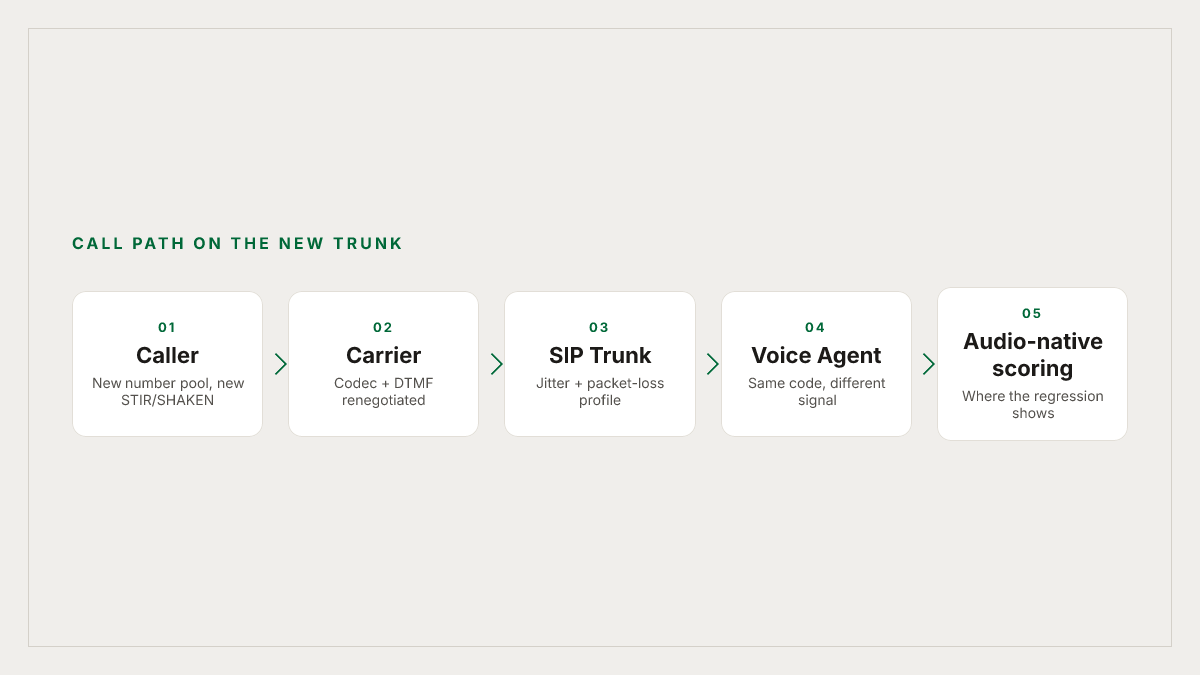
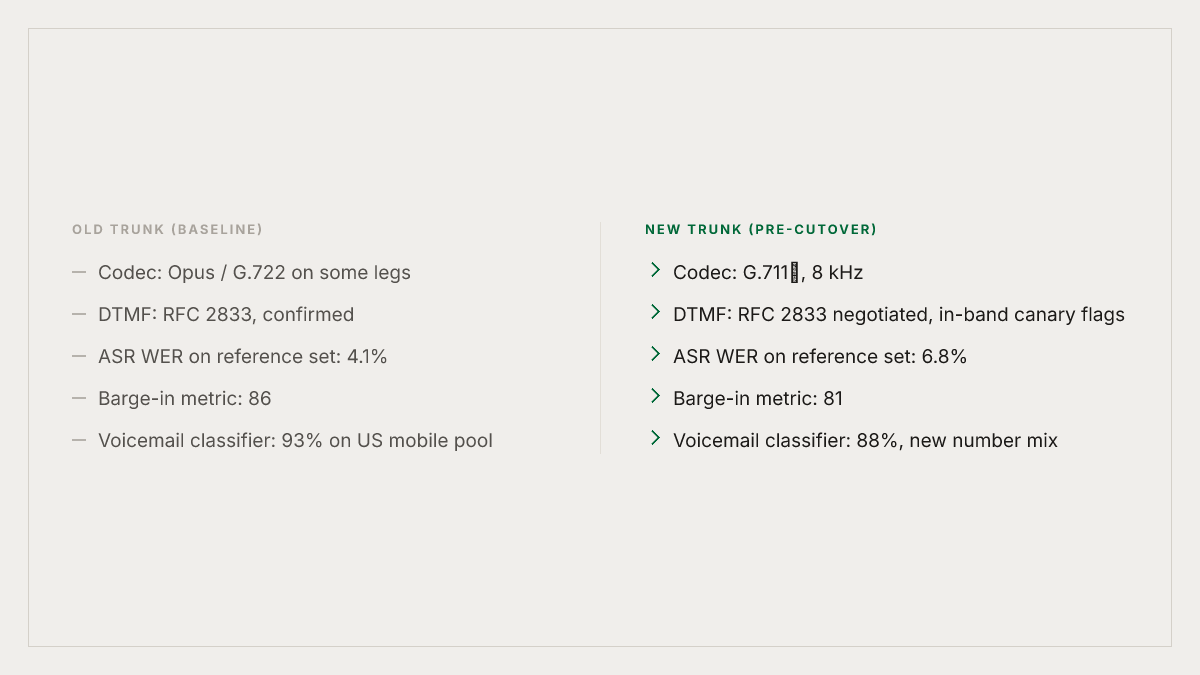
G.711 is the default, and that is the first surprise. Most SIP trunks carry G.711, sent as PCMU or PCMA, with Opus, G.729 and AMR-NB typically gated behind a sales conversation on Twilio's trunk. Telnyx supports Opus for WebRTC and AI-driven voice applications, but the trunk-to-agent leg is still almost always narrowband. As Picovoice puts it, the agent runtime is transport-agnostic; only the media edge differs, with PSTN and SIP traffic arriving through a telephony gateway in G.711 and WebRTC traffic arriving from browsers in Opus. If your previous trunk was quietly negotiating Opus or G.722 and the new one lands on G.711μ at 8 kHz, an ASR model that sounded clean in the browser demo can mishear words that only live in the 8 to 16 kHz band.
DTMF transport bites twice. The three transports are RFC 2833/4733 telephone-events, SIP INFO, and in-band audio. RFC 4733 sends DTMF as out-of-band telephone events inside the RTP stream rather than as in-band audio tones, and when an SBC's SDP negotiation drops the telephone-event payload type during codec offer/answer, the bot stops hearing "press 1". On AI-friendly carriers RFC 2833 is the default, but a swap can change which side initiates the offer and which payload types survive. The symptom is an agent that silently stops hearing account PINs on a specific tandem.
Caller ID attestation and spam labels. STIR/SHAKEN attestation level and the carrier's spam-likely tagging depend on which numbers you use, how they were acquired, and what the carrier does at the edge. A carrier swap is also a number-pool swap, and that moves answer rates and call-screening behavior independently of anything in the agent. Your answered-call distribution shifts, which shifts the conversation distribution, which shifts your metrics.
Voicemail greeting distribution. If the new carrier routes a different geography or a different mobile-vs-landline mix, the voicemails your agent encounters change. A nice illustration comes from a Retell community thread where an English-configured agent was dialing Spanish numbers, and voicemail detection broke because the ASR could not transcribe the greeting, so the classifier had no text to work with. A carrier that shifts country mix without a prompt change does the same thing more quietly.
Call-progress tones. Carriers differ on whether they send busy, reorder and SIT tones in-band as audio or map them to SIP response codes. An agent that was trained to ignore a short burst of tones on one carrier can treat the same burst as speech on another and start replying to a dial tone.
The test matrix a swap needs
Lock a baseline before you touch anything. On ten reference calls through the current trunk, capture SDP, negotiated codec, DTMF mode, measured jitter, STIR/SHAKEN headers, and the call-progress behavior for busy and SIT. Re-run your full pre-launch simulation suite against the agent so you have a known-good distribution.
Then under the new trunk, prove six things end-to-end:
- Codec and sampling. ASR word-error rate on a reference phrase set, scored on audio captured through the real trunk, not on demo recordings.
- DTMF transport. Keypad input tested end-to-end, including a canary that intentionally sends in-band to confirm the RFC 2833 path fails loudly rather than quietly.
- Latency and jitter. End-to-first-utterance, time-to-first-token, time-to-first-audio, all measured on the new RTP path.
- Voicemail detection. The same classifier, hit against a distribution of voicemails that reflects the new carrier's number mix.
- Transfer legs. Warm transfers and any re-INVITE media path through the new trunk, including the hold-music and reconnect behavior.
- Interruption and barge-in. VAD and endpointing react to jitter and codec. If barge-in regresses, it will show on the new trunk first.
That matrix is not optional. It is the delta between a clean cutover and a week of trying to reason about live traffic by hand.
Pre-launch: run the simulation suite through the new trunk
The right posture is to point your pre-launch simulation at the agent's new trunk and re-run the entire suite. Roark's simulation testing dials voice agents over real phone calls on PSTN and WebRTC, so the exact codec, DTMF mode and RTP path that production will use is what gets exercised. Personas carry distinct voices, languages and accents, speech pace, emotional register and background noise, so a carrier swap is not a single-condition canary; it is a distribution you can compare apples-to-apples against the baseline run you captured on the old trunk.
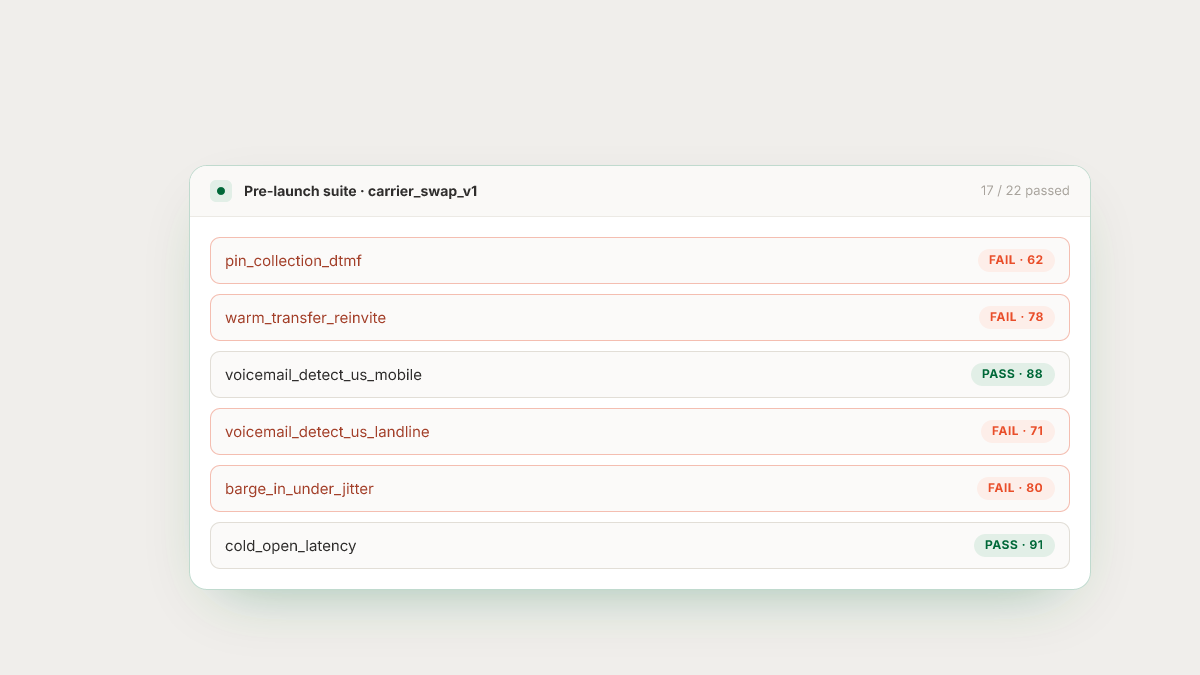
The failures the simulation catches are the ones that would otherwise show up a day later as "the bot is weird on one of our verticals." A PIN-collection flow that worked on Opus and fails on G.711μ. A barge-in metric that drifts five points when the new trunk's jitter budget is different. A voicemail classifier that drops confidence on a new country. Each one is a filed issue, each issue carries the replayable call, and each issue blocks cutover until it is green.
Simulations can be triggered over HTTP, so this entire re-run can gate a CI job: do not route production traffic through the new trunk until the carrier-swap suite passes.
Live: score every call on the new carrier
Simulation proves readiness. Live scoring proves reality. Once traffic starts flowing, every call on the new trunk gets scored on the same metric suite you use today, including audio-native metrics that read the sound of the call, not just the transcript: pronunciation, pace, interruptions, emotion and vocal stress. When the swap introduces a regression that only shows under real traffic, usually a specific carrier-interop quirk or a WER drop on calls routed through a particular tandem, the dashboard shows it before support tickets do, and the issue files itself.
OpenTelemetry traces on each call let you sit the audio-native scores next to the SDP, the negotiated codec and the jitter profile for the same call, which is the view you actually need when triaging a carrier swap. "This call dropped the interruption metric five points" becomes "this call dropped the interruption metric five points on G.711μ with 45 ms jitter, and here is the one before it on the old trunk."
Replay the pre-swap failures on the new trunk
The highest-leverage test when you change carriers is production call replay. The calls your old carrier was already losing, voicemails misclassified, DTMF missed, barge-in misfires, cold transfers that dropped, are ground truth. Replay them against the new agent configuration on the new trunk and you learn, within a day, whether the carrier change fixed them, left them intact, or broke something new. Without replay you are waiting a week for real traffic to re-hit the same edges, and you are negotiating with whichever customer surfaces it first.
Production call replay captures real calls and re-runs them against updated agent logic, which includes the new telephony edge. The same failure modes you shipped the swap to fix become regression tests you run forever.
The checklist before you flip traffic
- SDP and negotiated codec captured on both trunks, side by side
- DTMF mode negotiated and confirmed, not assumed
- ASR WER on a reference phrase set, measured on audio captured through the new trunk
- End-to-first-utterance latency budget met
- Voicemail detection accuracy on the new number pool and country mix
- Warm-transfer re-INVITE tested through the new trunk, including hold-music behavior
- Interruption and barge-in metric stable or improved versus baseline
- Production replay suite re-run against the new config, clean
- Live dashboards configured and alerting before cutover, not after
A carrier swap is cheap if you have a simulation suite and audio-native scoring. Without them it is the kind of change that teaches you about SDP, RFC 4733 and call-progress tones the hard way, at 3 AM, after a customer calls support with a story about a bot that went silent.