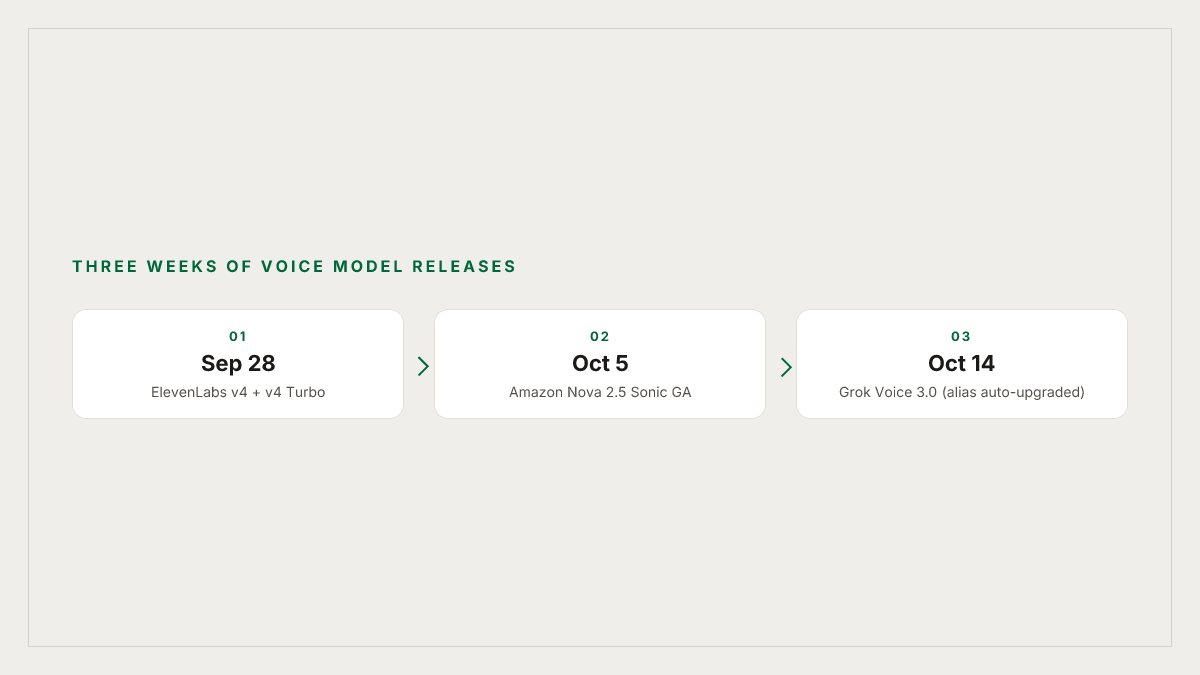
In the last three weeks, the model under your voice agent has probably changed. Grok Voice 3.0 shipped on October 14 and, per xAI's own release notes, the grok-voice-latest alias now points at it, so sessions on the alias were upgraded automatically. Amazon Nova 2.5 Sonic went generally available on October 5 with the same pricing as Nova 2 Sonic and promised reasoning, instruction-following and tool-call improvements. ElevenLabs released v4 and v4 Turbo on September 28, the Turbo variant aimed squarely at real-time voice agents.
For a PM running a production voice agent, this cadence creates a problem that didn't exist two years ago. The thing determining how your caller is handled, interrupted, understood and quoted-to can now shift between Monday and Tuesday without a line of code changing in your repo. The question is not whether to adopt the next model. The question is how you prove, before your customers do, that the swap did not regress the only calls that matter: yours.
The leaderboard is a signal, not your eval
The current public reference point is the Artificial Analysis Speech to Speech Index, which equally weights four components: Big Bench Audio for speech reasoning, τ-Voice for agentic performance, Arena Preference, and Task Success Rate. It's a useful cross-model yardstick. It's also measuring something very different from your agent.
Grok Voice 3.0 debuted at #1 on the Index at 86.9, up from 81.3 for Grok Voice 2.0. That number includes τ-Voice tasks across airline, retail, and telecom customer-service situations. If your agent books appointments for mobile dental hygienists, verifies insurance eligibility, or triages FNOL claims, almost none of your real traffic is in that distribution. Big Bench Audio reasoning questions do not sound like your callers. Arena preference voting does not reflect how your personas interrupt, trail off, or spell out confirmation numbers.
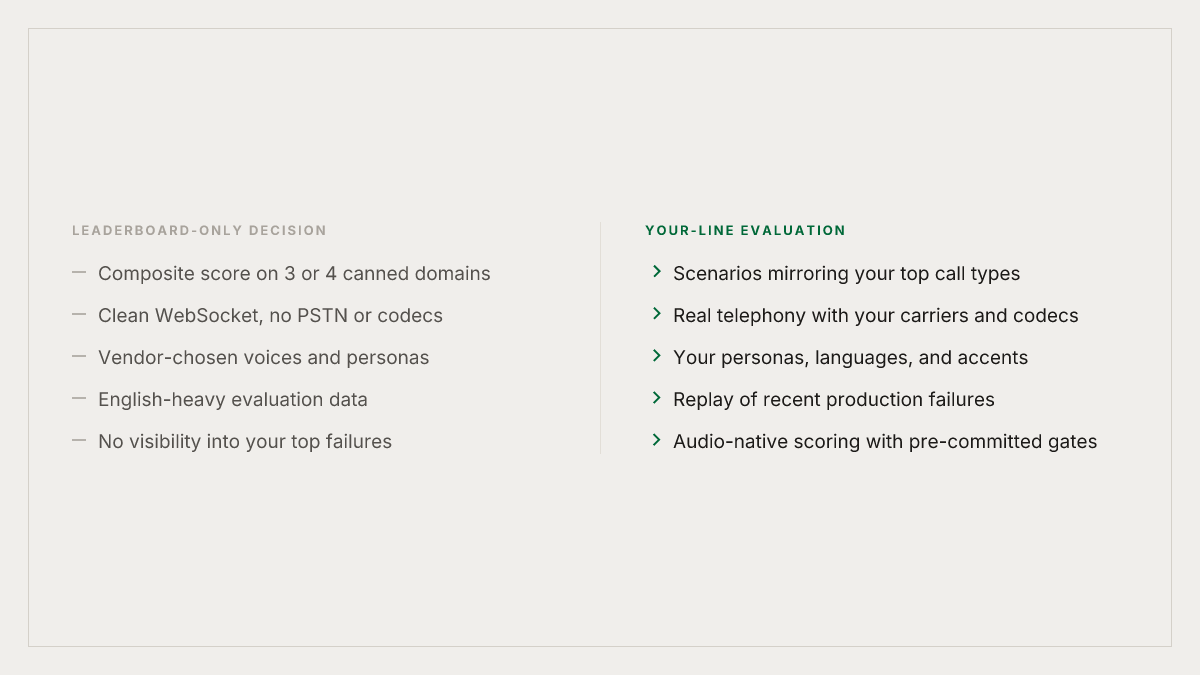
Benchmarks tell you which models are worth testing. They do not tell you which model wins on your line. The composite score hides exactly the thing you need to see: whether this new model, with your prompt, your tool catalog, your telephony stack, and your actual caller base, scores better or worse on the handful of call types that drive your business.
Three ways the swap can bite you
Before writing the playbook, it helps to be concrete about the failure modes.
The alias flip. xAI documents this plainly: grok-voice-latest now points to 3.0, with the API unchanged. If anything in your stack, your SDK default, a sample from docs you forked, a notebook used by an engineer to spin up prototypes, resolves latest at session time, your model moved. One review of the release makes the right call for production: pin an explicit version and move on purpose, after a round of test calls.
The same-price upgrade. Nova 2.5 Sonic shipped at the same price as Nova 2 Sonic. That makes the adoption decision look free. It isn't. A model that's smarter at tool calling can also be chattier, slower on specific intents, or more confident when it should defer. Free upgrades are not free regressions.
The vendor telling you where it won. Grok Voice 3.0 lands at #1 overall, but GPT-Live-1 (Astra, medium) still leads on τ-Voice at 74.5% to Grok's 71.6%. Both are useful facts; neither tells you which model handles your spoken-DOB capture better in Spanish. "State of the art on a public benchmark" and "best for your use case" are different sentences.
The PM playbook: an eight-step swap
The pattern below works whether you're swapping the speech-to-speech brain (Grok, Nova Sonic, GPT-Live, Gemini Live), the TTS layer (ElevenLabs v4, Cartesia), or the ASR in a cascaded stack. The point is not to block upgrades. The point is to make upgrades a decision with evidence instead of a thing that happens to you.
1. Inventory where models are consumed, and what is pinned
Before anything else: produce a one-page table of every place your product uses a voice model, what version string is set, and whether that string is a floating alias or a pinned version. Include notebooks, prototype flows, sandbox tenants, and the IVR fallback that nobody has touched in six months. Floating aliases are not evil, but they are not production-safe. grok-voice-latest and similar aliases belong in dev; pinned versions belong in prod.
2. Pin everything in production
Pin to a specific version in every production path. This is a prerequisite for everything else: if the version can change under you, your test results are describing a state that no longer exists. Production teams should pin an explicit version rather than the alias. Treat this as table stakes.
3. Build your own scenario suite before you need it
The eval that matters is the one that mirrors your top call types, in your languages, across the personas you actually serve. For most teams that's twenty to fifty scenarios covering: the three or four happy paths that account for most volume, the escalation paths you promise your ops team will work, the authentication steps where ASR errors become compliance incidents, and the long-tail intents your humans would rather not handle. Each scenario needs a defined caller persona (voice, pace, accent, emotional register, background noise), an expected outcome, and a small set of metrics it must clear.
The vendor-neutral form of this suite outlives any one model. Nova 2.5 Sonic will not be the last upgrade, and the agent you ship next quarter needs the same tests.
4. Simulate over real telephony, not a text loopback
This is where the gap between a benchmark and your eval gets widest. Public leaderboards score models through APIs. Your callers reach you through PSTN, carriers, codecs, jitter, and the specific telephony integration you've chosen. Model behavior that looks fine over a clean WebSocket can degrade meaningfully once it rides a call with real audio in both directions.
Roark runs this part. Simulations are dialled against your agent over real phone calls (PSTN) and WebRTC with configurable personas, and both inbound and outbound are supported, so Roark can dial your agent's phone or SIP endpoint, or provision a number your agent dials, triggered automatically over HTTP so runs can gate CI. That last piece matters when a model vendor ships weekly: your eval needs to run on demand, not when QA has a quiet afternoon.
5. Score on audio-native metrics, not transcript-only ones
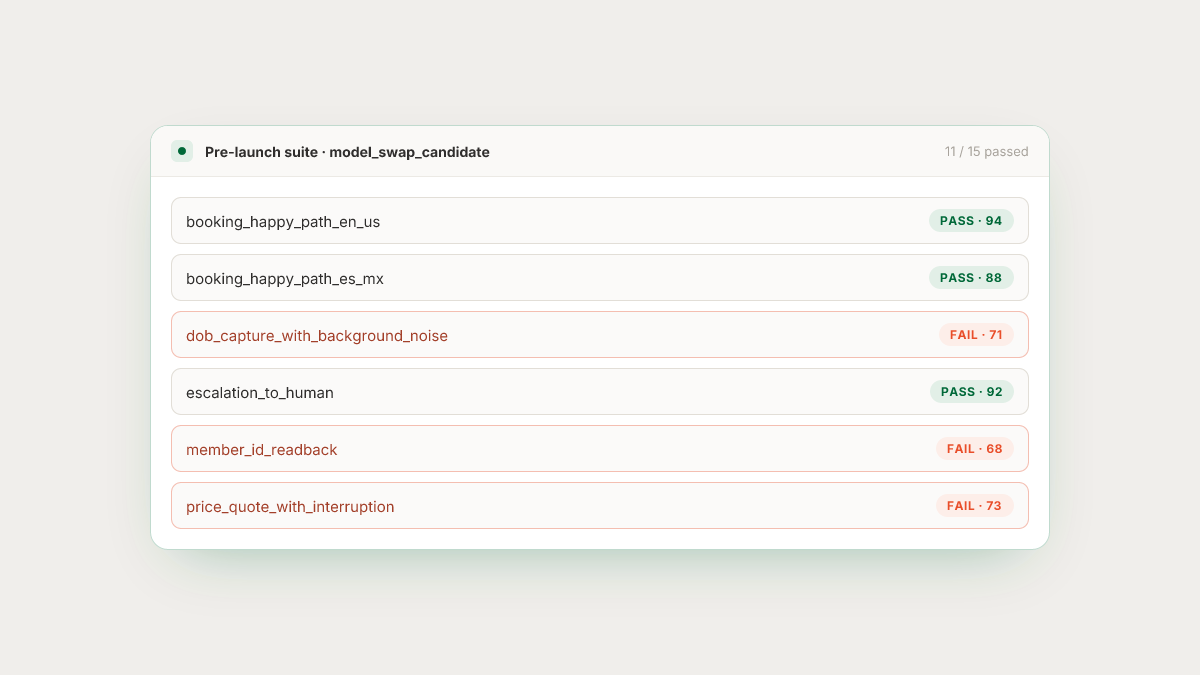
A transcript comparison can tell you the words were right. It cannot tell you the agent cut the caller off, mispronounced the member ID, sounded stressed when quoting a price, or sat silent for 2.8 seconds while a tool call completed. Those are the moments that drive CSAT and churn, and they are exactly the places a model swap can regress silently. Score on the sound of the call: pronunciation, emotion, vocal stress, pace and pauses, interruptions. Roark's audio-native models cover these out of the box, with 64+ built-in metrics and unlimited custom ones.
6. Replay recent production failures against the candidate
Your most honest regression suite is the set of calls where your current agent already failed, or barely passed, last month. Capture them, replay them against the candidate model, and compare. If a swap fixes ten long-standing failures and introduces two new ones, that's a decision you can take to the business. If it fixes none and introduces ten, the model is better on a leaderboard and worse on your line. Roark's production call replay turns real failures into repeatable regression tests, which is exactly the shape of test a model swap needs.
7. Canary with hard metric gates
Promote the new model to a small slice of real traffic (5 to 10 percent is a common starting point), with explicit metric thresholds that will roll you back automatically. The thresholds come from your scenario suite: if interruption rate on authentication flows jumps above baseline, if time-to-first-audio drifts past a limit, if task-completion drops on your top three intents, you revert. The canary is not "watch Slack and hope." It is a time-bound experiment with pre-committed stop conditions.
8. Lock the version, keep the suite
Once the canary clears, pin the new version everywhere and update your inventory. Then keep the scenario suite running on a schedule against production. The next model will arrive. Grok Voice 2.0 shipped in July and Grok Voice 3.0 shipped in October; the cycle is now measured in months, not years. The team that treats evaluation as a standing capability will adopt faster and sleep better than the team that assembles a one-off eval every time a vendor posts to X.
What good looks like
A healthy voice-agent QA process for a team on a frontier speech-to-speech model looks something like this: pinned versions in production, a persona-driven scenario suite that runs over real telephony on every meaningful change, replay of last week's worst production calls as a standing regression, audio-native scoring across the whole suite, and a canary gate that promotes new models when they beat the current one on your metrics, not a leaderboard's.
That shape is why we built Roark the way we did: simulation testing over real phone calls as the core, audio-native scoring on every live call, and automatic issues on anything that regresses. When Nova 2.5 Sonic went GA, the AWS announcement itself named customer service, personal AI assistants, and real-time conversational applications as the targets. Those three categories cover a lot of regulated, high-stakes voice work, including healthcare and insurance, where a bad swap is not just a CSAT dip.
The 48-hour version
If you need to react to today's news and don't have the playbook in place yet, do this:
- In the next 24 hours, grep your repos and vendor dashboards for
latestaliases. Pin them. - Pick your three highest-volume call types. Define five scenarios each, with explicit personas and expected outcomes.
- Run those fifteen scenarios through the current pinned model and the candidate, over the same telephony path your callers use.
- Replay the ten worst production calls from the last two weeks against both.
- If the candidate wins cleanly, canary at 10 percent with a one-week watch window and metric-based rollback.
That is not a complete QA function. It is enough to make the next swap a decision instead of a surprise. The complete version is the standing capability: a persona suite that mirrors your business, running on a schedule, over real calls, against whatever version your team has pinned, and ready to light up the moment the next provider ships.
The voice model under your agent will change again. Soon. The teams that treat each refresh as a repeatable evaluation, instead of a scramble, are the ones that get to spend their energy on product and not on cleanup.