On October 14, SpaceXAI shipped Grok Voice 3.0 and it debuted at number one on the Artificial Analysis Speech-to-Speech Index with a composite score of 86.9, ahead of OpenAI's GPT-Live-1 at 83.2. The release notes read like a PM's dream: sub-second time to first audio, lower cost per task than frontier competitors, and the same per-minute price as the previous version. If you run a voice agent, your first thought was probably the right one: should we switch?
The honest answer is that the leaderboard cannot tell you. A public benchmark is a shortlist, not a decision. It measures a model under conditions that are not your conditions, scored against tasks that are not your tasks, with metrics that are not your KPIs. Treating a leaderboard score as a procurement signal is how teams end up swapping models every six weeks and wondering why nothing feels more stable.
What the Speech-to-Speech Index actually measures
Give the Artificial Analysis team credit. The Speech-to-Speech Index is the most rigorous public ranking we have for native audio models, and it is open about its methodology. The composite is an equal-weighted average of four dimensions:
- Speech Reasoning (Big Bench Audio). A thousand reasoning questions covering fallacies, navigation, object counting, and web of lies, delivered as speech.
- Conversational Dynamics (Full Duplex Bench). Pause handling, turn taking, interruption handling, and backchannel handling, scored as the percentage of samples the model gets right.
- Agentic Performance (τ-Voice). 278 grounded customer-service tasks in retail, airline, and telecom, graded deterministically against the final state of a database.
- Arena Preference and Task Success Rate. Blind head-to-head calls with real people, scored both on which model they preferred and whether the task got done.
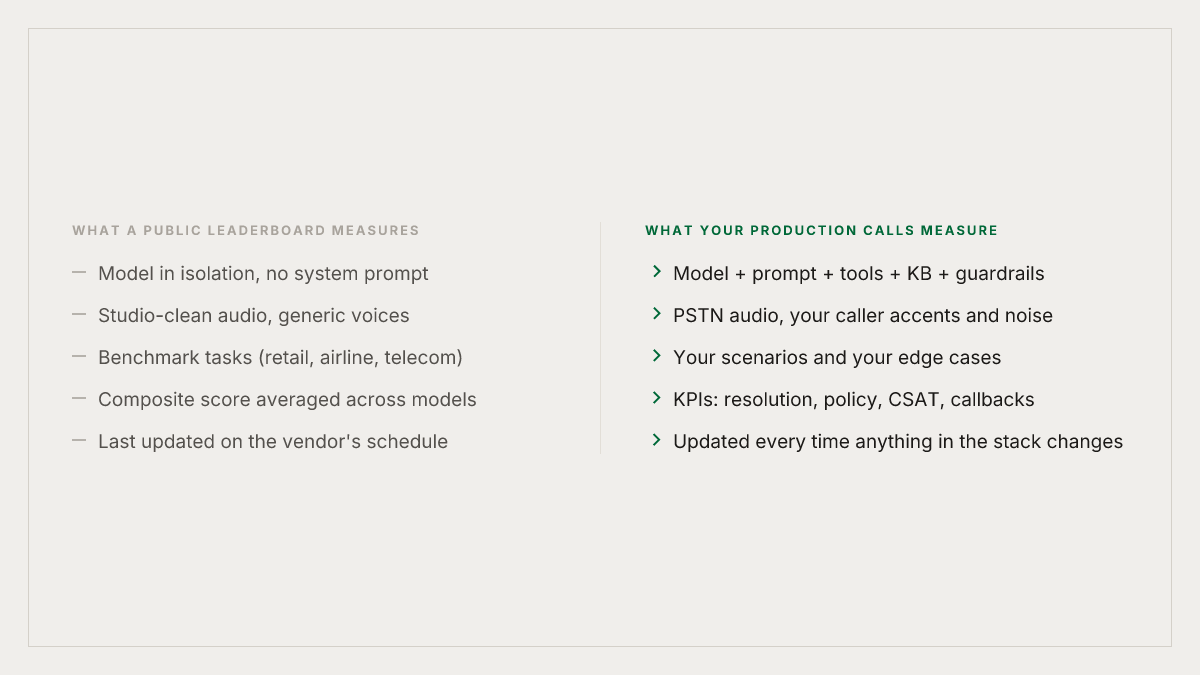
These are good things to measure. They are not measurements of your agent. The models tested here are tested without your system prompt, without your tool chain, without your knowledge base, over audio that is not your telephony stack, with callers who are not your callers, scored on metrics that are not your business.
Why topping the index can still fail your calls
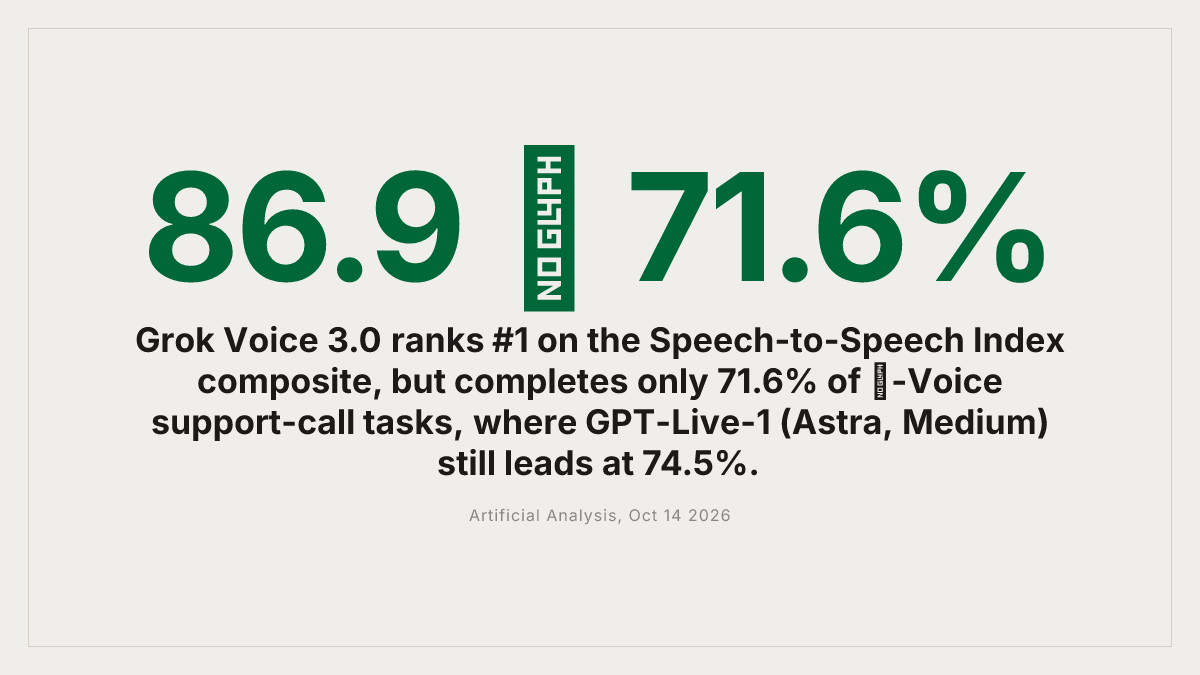
Look at Grok Voice 3.0 one layer below the composite. The index is 86.9 and ranks #1. On τ-Voice, which simulates real support calls with accents, background noise, and callers interrupting, the score is 71.6%, and GPT-Live-1 (Astra, Medium) still leads that specific benchmark at 74.5%. On Speech Agent Arena preference, which is blind head-to-head with real humans, Grok Voice 3.0 ranks third behind two Gemini models.
So which is the "best" model? All three answers are defensible, which means none of them is an answer at all for a specific agent. The τ-Voice work makes the point concretely: GPT-5 solves 85% of the same tasks when given text input, but voice agents reach only 31 to 51% under clean audio and 26 to 38% under realistic conditions. The entire voice modality carries a 30 to 60 point task-completion tax that the leaderboard composite smooths over. And the authors are blunt about the cause: 79 to 90% of failures stem from agent behavior, not deep reasoning failures, which means the gap between models is often smaller than the gap between a model and the agent you built around it.
The pattern repeats every time a new frontier voice model ships. One component moves fifteen points, another is unchanged, latency ticks up slightly, cost holds. Whether that is a win for your agent depends entirely on where your agent currently fails.
The gap between a leaderboard and your production
A fair test of a model, as a replacement for the model you ship today, has to control for everything that is not the model. In production, that includes:
- Your system prompt and policies. Policy adherence is where most agent failures live, and prompts interact with models in ways that are not transferable. A prompt that worked beautifully on GPT-Live-1 can fall over on a model with different attention to long instructions.
- Your tool chain. Tool-call latency, tool error semantics, retries, and partial responses are all part of the real conversation. A benchmark that reports LLM-only latency, like Inception's 320ms median first-token figure, is useful but does not predict the end-to-end call.
- Your telephony stack. PSTN codec quality, jitter, packet loss, and the carrier path a given number traverses. Public benchmarks run on clean studio audio.
- Your caller mix. Regional accents, bilingual callers code switching mid-sentence, elderly callers with slower pace, callers in cars, callers on speakerphone with a TV in the background. Your distribution is your own.
- Your KPIs. τ-Voice measures final database state. Your business probably cares about resolution, callback rate, policy compliance, complaint rate, and CSAT. Those do not correlate one-to-one with task completion.
The uncomfortable implication: a model that is objectively better in general can be measurably worse on your calls, and a model that scores average on the Speech-to-Speech Index can be the right pick for your traffic. You will not know which until you test it against your agent.
What a real benchmark for your agent looks like
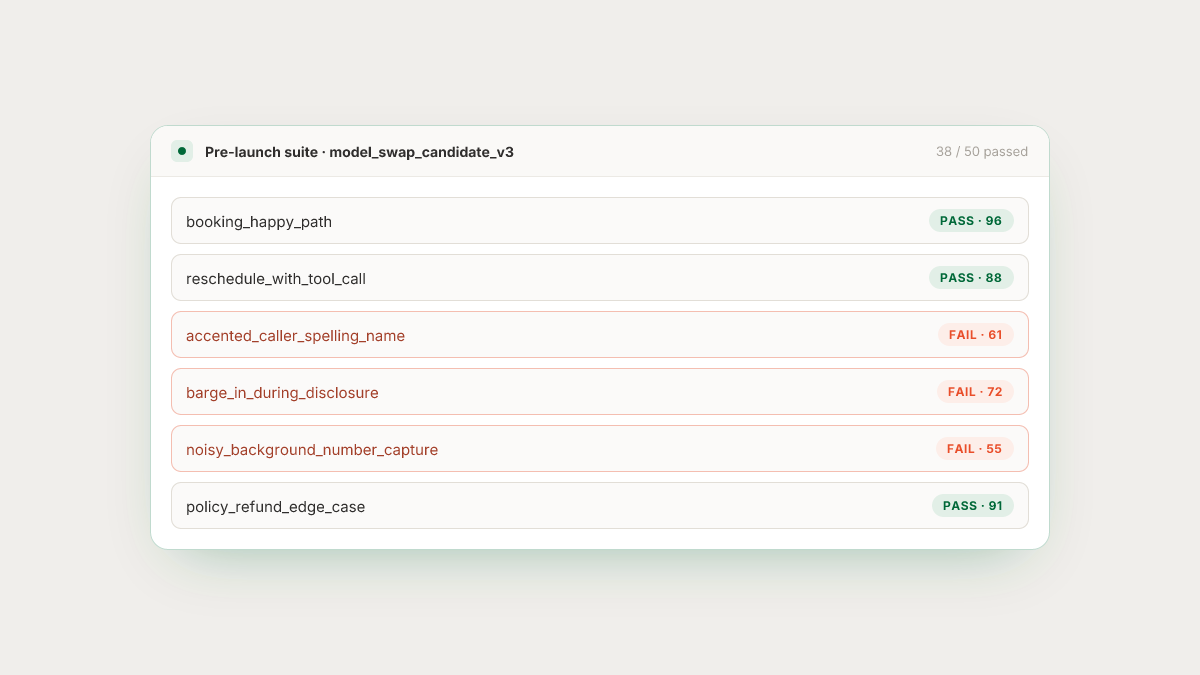
A benchmark worth basing a model-swap decision on has four properties. It is representative, it is deterministic where it can be, it is scored on metrics that mean something to your business, and it is cheap enough to run on every candidate.
Representative means your scenarios come from your production calls. Start by tagging a few hundred real calls across the behaviors you care about: common happy paths, the top handful of failure modes, the long tail of weirdness. Each tag becomes a scenario. Your personas carry the voices, accents, and audio conditions you actually see, not a generic American voice reading a script in a quiet room.
Deterministic where it can be means that every scenario has a verifiable end state. For a booking agent, that is a confirmed appointment with the right datetime and customer id. For a claims-intake agent, that is a FNOL record with the required fields populated and the right coverage lookup performed. Soft metrics (tone, pace, backchannels, interruption handling) sit alongside the deterministic ones, scored by audio-native evaluators rather than transcript heuristics.
Scored on your metrics means your scorecard reflects the things leadership asks about: resolution rate, policy adherence, PII handling, disclosure compliance, average handle time, barge-in behavior, pronunciation of your brand names and SKUs. A composite that averages those is useful. A composite that averages Big Bench Audio and Arena Preference is not.
Cheap to run means the full suite completes in minutes, not days, triggered on demand or on a schedule. If running the benchmark is an event, you will not run it on every candidate model, every prompt change, every tool rev. You will test once, ship, and hope.
A model-swap decision process that holds up
For PMs weighing a model change, a workable sequence looks like this:
- Use leaderboards to shortlist. Public rankings are great for ruling out models that are plainly worse on dimensions you care about. If a candidate ranks poorly on Full Duplex Bench and your callers interrupt constantly, you can skip it.
- Run the candidate against your sim suite. Same scenarios, same personas, same audio conditions as the incumbent. Compare pass rates per scenario, not averages. A candidate that beats the incumbent overall but regresses on your top failure mode is often a bad trade.
- Replay real production calls against the candidate. The real distribution of your traffic is only in your traffic. Replay a representative sample through the new model and score the deltas on the same metrics you track in production.
- Shadow in a canary. For a subset of real inbound calls, run both models in parallel and compare outcomes offline. This catches issues that neither simulation nor replay surface, usually around tool-call timing and barge-in in live conditions.
- Decide on your KPIs. Not on the AA Index, not on τ-Voice, not on the vendor's marketing chart. On resolution, policy compliance, and CSAT for your agent.
The whole sequence should take days, not quarters, and it should repeat every time a new model lands. If it takes months, you will keep running an older model while the market moves, or you will swap in blind and absorb the regression. Neither is acceptable.
Where Roark fits
This is the problem Roark was built for. The platform dials your agent over real phone calls (PSTN and WebRTC) from configurable personas, in 45 languages and accents, with the voices, pace, emotional registers, and background-noise conditions that match your production distribution. Scenarios are versioned, scheduled, and triggered over HTTP so a candidate-model run can gate a deploy from CI. One-click integrations with Vapi, Retell, LiveKit, Pipecat, Bland, and ElevenLabs mean you point Roark at your agent as it exists today, no scaffolding.
Every call, simulated or real, is scored against 64+ built-in audio-native metrics that look at pronunciation, emotion, vocal stress, pace and pauses, and interruptions, plus any custom metrics tied to your KPIs. When a metric fails, Roark files it as an issue, with the audio, transcript, and context attached. Production call replay turns real failures into repeatable regression tests, so the long tail you discover in week six is still a scenario in week six hundred.
That is the shape of a benchmark that is worth basing a model decision on: your traffic, your conditions, your metrics, scored the same way whether the call was simulated or real.
Treat the leaderboard as a shortlist
Public benchmarks are not useless. They tell you where general capability is heading, they expose vendor claims to independent scrutiny, and they help you ignore models that are not worth testing. The team at Artificial Analysis is doing the field a favor by publishing a methodology instead of a vibe. That is the right use of a leaderboard.
The wrong use is treating a number produced on someone else's workload as evidence about yours. Grok Voice 3.0 leads the index this week. It may lead your production calls. It may not. The only honest way to find out is to run your agent against your scenarios, score the audio with metrics that reflect your business, and compare the deltas. Everything else is a wishlist.