
On November 17, Twilio moved two new Conversation Intelligence operators into public beta: Task Completion and Hallucination Detection. Both run after the call ends, on the transcript, comparing what the agent said against the knowledge base and the rest of the conversation. The feature has a clear, useful job: give ops teams a cheap way to spot ungrounded answers across every call instead of sampling a handful by hand.
It is also already being treated, in some decks I have seen this week, as "QA for voice agents". It is not. It is supervision, and the distinction matters, because a QA program that ships based on transcript-only, post-call hallucination scores will miss the failures that cost you the most on a live phone call.
What Twilio actually shipped
The two operators are part of a broader push by Twilio to help teams move AI voice agents from demos into production calls. Twilio announced a set of Conversation Relay, Agent Connect and Conversation Intelligence updates on November 17, including Smart Turn Detection and automated STT failover reaching general availability, and the two new supervision operators landing in public beta.
Here is the mechanical shape of the hallucination operator, per Twilio's launch post: "Hallucination Detection checks claims your agent makes against the knowledge articles you shared with it and against the rest of the conversation." A companion guide from Twilio adds that it checks against Enterprise Knowledge and Conversation Memory, flagging each statement that conflicts. Task Completion labels each conversation's outcome with a one-sentence reason.
Three mechanics to hold onto before we go further:
- The operators run on the transcript, not on the audio of the call.
- They execute after the call finalizes. Twilio's docs are explicit: Language Operators run on finalization of the transcript, which happens when the call ends.
- They are post-production supervision, by design. The product page describes them as helping teams evaluate real customer conversations without changing agent code or installing SDKs, and the operators are currently a public beta not covered by Twilio's SLA.
Nothing in that list is bad. All of it is useful. The problem is the words "evaluate" and "hallucination" sliding, in PM conversations, into the words "tested" and "safe to ship".
Why transcript-only is not the whole story
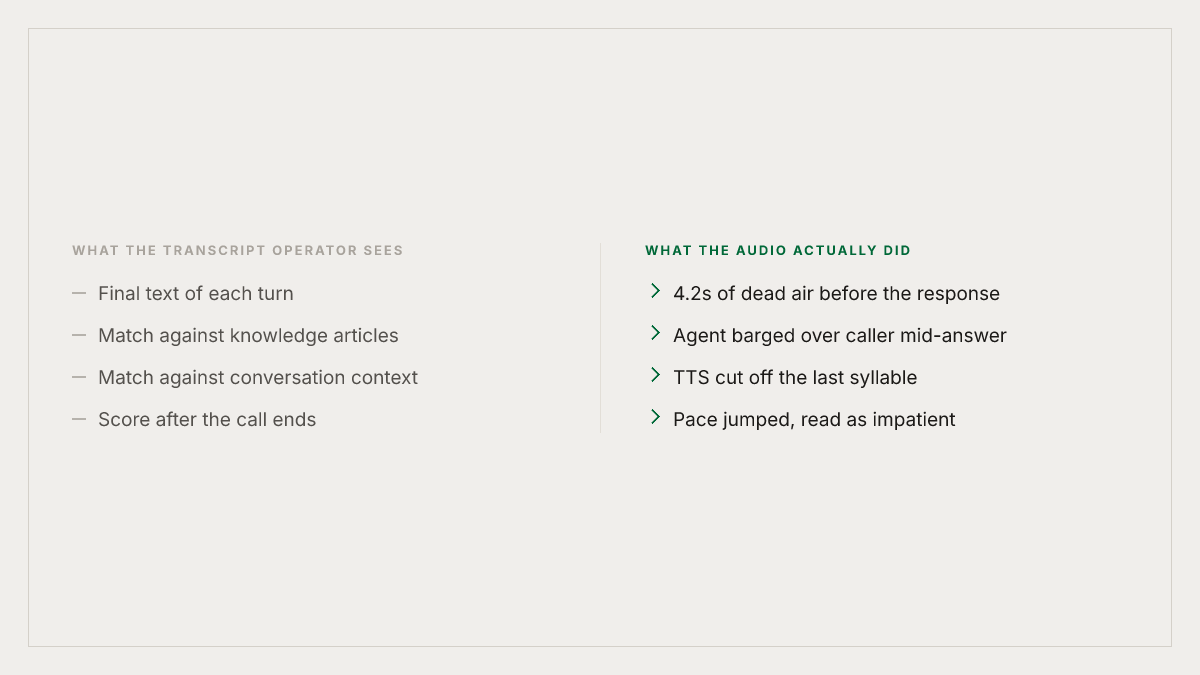
A voice agent fails in two very different places. There are the things it says (the wrong refund amount, a policy that does not exist, a confirmation it had no right to give) and the things it does with its voice (interrupts the caller, leaves 4 seconds of dead air, cuts off a sentence halfway through, barges over a yes/no because its VAD misfired).
Transcript operators catch some of the first category. They catch essentially none of the second.
Research on hallucination detection keeps bumping into the same ceiling. Normalization and ASR itself can scrub the symptom before the evaluator sees it. FutureAGI's explainer on caption hallucination puts it plainly: "Normalization may remove the hallucinated phrase before evaluation sees it," and successful-looking calls may carry false transcript evidence that silently changed a tool argument. So even for the "what it said" bucket, a transcript-only operator is only as truthful as the transcript it inherits.
Then add the second bucket, which the transcript cannot represent at all. Twilio's own launch is honest about why callers lose trust: customer trust is shaped by whether your agent interrupts, whether audio is clear, and whether the call stays connected. That is also, almost exactly, the surface area that a text-after-the-fact operator cannot see. The transcript shows the sentence. It does not show the four seconds of silence before it, the step-on where the caller got cut off, or the sudden pace change that read, to the caller, as the agent being annoyed.
This is not a Twilio-specific limitation. It is physics. Transcripts are a lossy projection of a phone call, and anything you grade on that projection grades only what survived the projection.
Supervision, evaluation, and QA are not synonyms
Here is the vocabulary I use with teams, because it stops a lot of arguments:
- Supervision is a background process that watches live traffic and flags things to review. Twilio's operators are supervision. Transcript scorecards are supervision. Human call review is supervision.
- Evaluation is scoring a known input against an expected behavior. You are either running evaluation on captured production calls (slow feedback, but real) or on simulated calls (faster, but only as good as your scenarios).
- QA is a decision function. It answers "is this change safe to promote?" It must run before the change goes live, it must be reproducible, and it must gate release.
Post-call hallucination operators are a supervision tool. They tell you what has already happened to real callers. They do not tell you what will happen when you push the prompt change your team shipped this afternoon, and they cannot tell you before it ships, because the mechanism only exists at call finalization.
The industry is quietly aware of this. The Elastic acquisition of HoneyHive, announced November 23, was pitched explicitly around "enhanced visibility into AI agent operations" for debugging and security. Visibility. Not testing. Supervision and QA are both legitimate categories, but treating one as the other is how teams end up launching regressions and finding out about them from a dashboard a week later.
The failures a post-call operator will never save you from
Think about what has to happen for a transcript-based hallucination operator to prevent harm.
- The agent says something wrong on a live call with a real customer.
- The call ends.
- The transcript is finalized and sent to the operator.
- The operator flags the statement.
- Someone reviews the flag and decides to fix the agent.
- The fix ships.
- The next real customer is no longer at risk from that specific failure.
The real customer in step 1 still heard the wrong refund quote. The twenty callers between step 1 and step 6 heard it too. If the same operator is also your "QA", nobody stopped step 1 from happening in the first place.
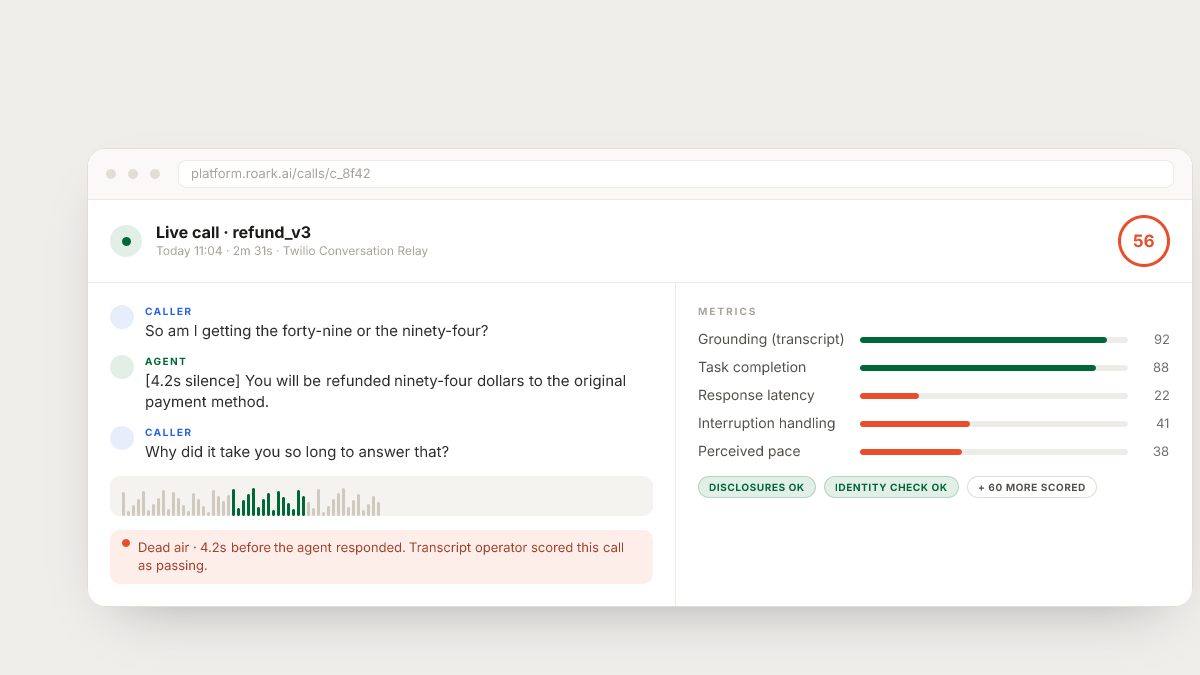
Compare that with the shape of a failure like dead air before a response. The audio-side failures that destroy trust rarely show up in the transcript at all, because dead air is the absence of words. A transcript scored "no hallucinations detected, task completed" can describe a call where the agent sat silent for seven seconds, then cut off the caller, then said the right thing. From the operator's perspective, that is a passing call. From the caller's perspective, it is the call they hang up on and never call back.
What a real QA loop for a voice agent looks like
Separate the jobs and you get a cleaner picture. You want all three layers, and you want each one doing what it is actually good at.
| Layer | When | What it grades | What it decides |
|---|---|---|---|
| Pre-launch simulation | Before any real customer talks to the agent | Audio and transcript of simulated calls against scenarios you authored | Whether this build is allowed to ship |
| Live scoring | Every production call, as it happens | Audio-native metrics plus transcript checks on every call | Which live calls need review and remediation |
| Supervision operators | After the call, on the transcript | Grounding, task completion, policy keywords | Which trends and content errors to feed back into prompts and knowledge |
Twilio's operators sit squarely in row three. They are good at that row. They should not be your row one.
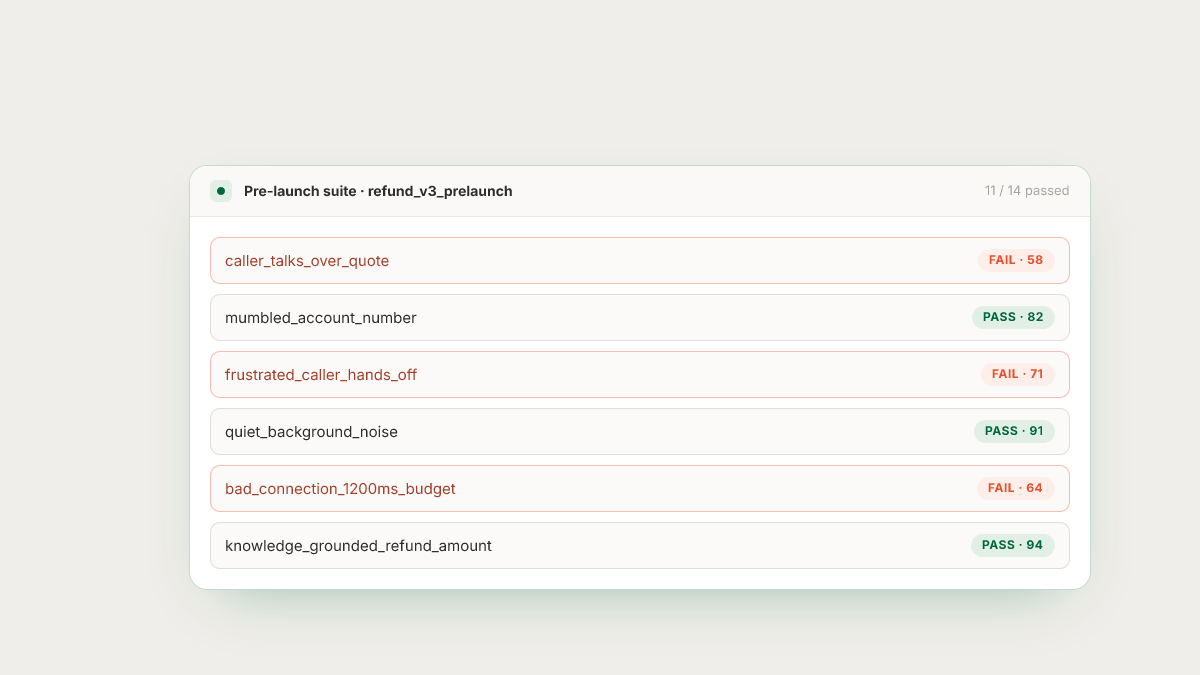
The row one job, pre-launch, is what Roark was built for. Roark dials your agent over real phone calls (PSTN and WebRTC) with personas that define voice, language and accent, speech pace, emotional register, and background-noise environment. Scenarios and run plans let you replay the failure modes you care about on a schedule, and the whole thing can be triggered over HTTP so a CI job can gate a release on a fresh simulation run. That is the layer that answers "is this build safe to ship", because it runs before the build ships.
The row two job, live scoring, is where audio-native metrics earn their keep. Roark scores every production call against 64+ built-in metrics plus any custom metrics you add, and those metrics grade the sound of the call: pronunciation, emotion, vocal stress, pace and pauses, and interruptions. That is the row where the dead-air and barge-in failures finally show up, because a model is listening to the audio, not reading a transcript of it. Issues get filed automatically when a call fails a metric, and the same production call can be replayed against your updated agent as a regression test.
That last capability is what closes the loop. A transcript operator tells you a bad call happened. A production call replay turns that bad call into a test case that the next build has to pass before you promote it. One is supervision, one is QA, and only one of them prevents the same failure from happening again.
Where Twilio's operators do fit
I am not arguing against the Twilio feature. I am arguing against the misuse of it.
If you run voice agents on Conversation Relay, turn the operators on. For the subset of hallucinations that survive the transcript, they will give you cheap signal at scale on 100% of calls, which beats sampling fifty conversations a week. Pair them with the On-Demand Execution API, now generally available, to re-score historical transcripts when your knowledge base changes. Feed the trends they surface back into your scenario library so that the failure patterns become pre-launch test cases, not recurring production incidents.
Just do not let them be the last word on whether a build is safe. The questions a pre-launch QA stack has to answer are:
- Does this agent still handle a frustrated caller who talks over it without becoming rude?
- Does it still recover when the caller mumbles the account number?
- Does it still route to a human in the three cases where the compliance team says it must?
- Does the new TTS voice still land under a 1200ms response time on a bad connection?
- When the model vendor pushes a silent update, do my gold-standard scenarios still pass?
None of those get answered by a transcript operator that runs after the call. All of them get answered by a simulation harness that runs your scenarios over real audio before you promote. That is the layer the Twilio launch does not cover, and it is the layer that stops regressions from touching real callers in the first place.
The takeaway
Transcript hallucination operators are a good addition to the voice AI stack. Teams that treat them as QA will still ship regressions, because the mechanism is after the call, on the transcript, on live customer traffic. QA runs before customers, on the audio, against scenarios you chose. Keep supervision for what supervision is good at, and give pre-launch its own stack.
If you want to see what the pre-launch stack looks like in practice, the Roark docs walk through simulation runs, scoring, and production call replay against the integrations you already have. Twilio is one of them. So are Vapi, Retell, LiveKit, Pipecat, Bland, and ElevenLabs.