
In the last few weeks every major realtime stack shipped a smoother version of the same trick: when the agent decides to call a tool, it talks through the wait. OpenAI widened the filler library for GPT-Live 1.1 so the model stops looping on "checking..." during longer calls. Bland launched Tofu-1 with the explicit pitch that it listens while it speaks and never says a task is done before it is. GPT-Realtime-2 ships preambles as a default. Pipecat's LLMWithBackend pattern pairs a fast voice model with a heavier backend so the voice keeps talking while the backend runs the real tool.
All of this is good UX. It also quietly multiplies the ways your agent can lie to a caller mid-call, and almost none of it is visible in a transcript eval.
What a narrated tool call actually is
The classic cascaded pipeline runs ASR, then an LLM, then a tool call, then TTS, serially. During the tool round trip the caller hears silence. The OpenAI Realtime prompting docs reduce the fix to one line: before any tool call, say one short line like "I'm checking that now," then call the tool immediately. SignalWire's latency writeup describes the same mechanism from the caller's side. The tool still takes as long as it did; the caller hears "let me check on that" at 1.4 seconds instead of silence until 3.0, and perception shifts.
Full-duplex and backend-delegated architectures push the pattern further. Tofu-1 is marketed as full duplex: it listens and speaks at the same time, and what it hears can change what it is saying. Pipecat's LLMWithBackend pairs a fast voice model with a slower backend model that runs the tools, and the voice keeps talking while the backend works. NVIDIA's NemotronLabs VoiceChat paper describes a per-tool filler mechanism that triggers the moment the LLM emits the tool call, with phrase duration deliberately sized to mask the tool round trip.
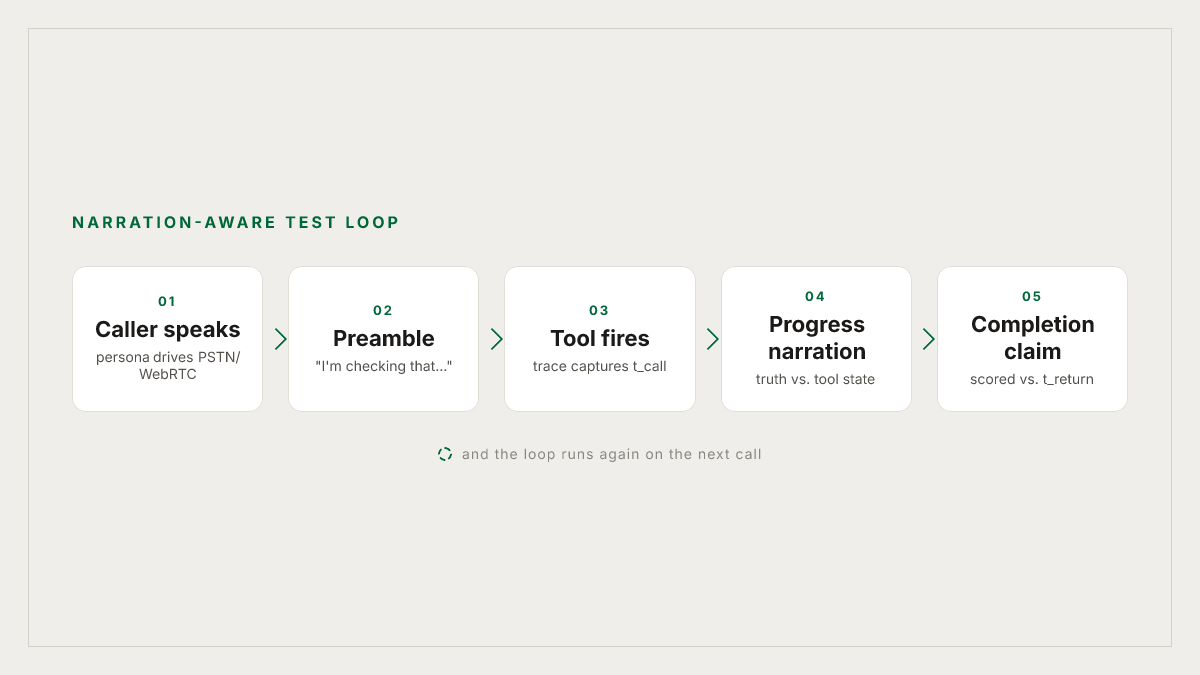
That is four distinct speech acts where there used to be one:
- Preamble: "let me check that now."
- Progress narration: "still looking, it is taking a second."
- Mid-tool clarification: "while that runs, should I text you the confirmation?"
- Completion claim: "okay, your flight is booked."
Each one has its own failure mode. Each one is audible to the caller before any of your downstream text checks run.
The four ways narration breaks the call
Narrated false done
The agent asserts completion while the tool is still in flight. This is the exact failure Bland called out when they shipped Tofu-1: the model should not claim a task is done before it is. In practice it happens because the voice model produced a completion-shaped utterance during the preamble window and TTS already played it. Whatever the tool eventually returns no longer matters, because the caller already heard they were booked.
Filler overlap interruption
The most expensive measurement in the recent Full-Duplex-Bench v3 paper is Ultravox's interruption rate. With an 88 percent filler rate, filler speech frequently overlapped the user's utterance, pushing the interruption rate to 47.9 percent and the task-completion latency to 8.40 seconds. The filler was supposed to hide latency. It ended up colliding with the caller every other turn, and deferring tool execution until after it finished inflated end-to-end latency instead of hiding it.
Narration-reality mismatch
The agent says "I see you're on the gold tier" while the account lookup is still running, then the tool comes back and the caller is on the silver tier. The spoken progress text and the tool result have diverged. The GPT-Live prompting guide names this guardrail explicitly: report only supplied tool state and verified results; never invent progress or claim changes. A good rule. It needs a test suite to enforce.
Stall on filler
A LiveKit agents issue filed this month is the cleanest reproduction of the opposite failure: with GPT-Live and the default responses delegation, a tool's result reaches the backend model only after the voice model's in-flight burst of speech has finished playing, plus an 0.8 second quiet window. For tools that return immediately from memory, nearly all of "tool plus hold" is the hold. The filler that was supposed to hide latency became the latency.
None of these are rare. All four are routine on production voice agents right now. All four follow directly from the architectural choice to narrate a tool call, and none of them survive an honest audit by a transcript eval.
Why your text eval misses all of this
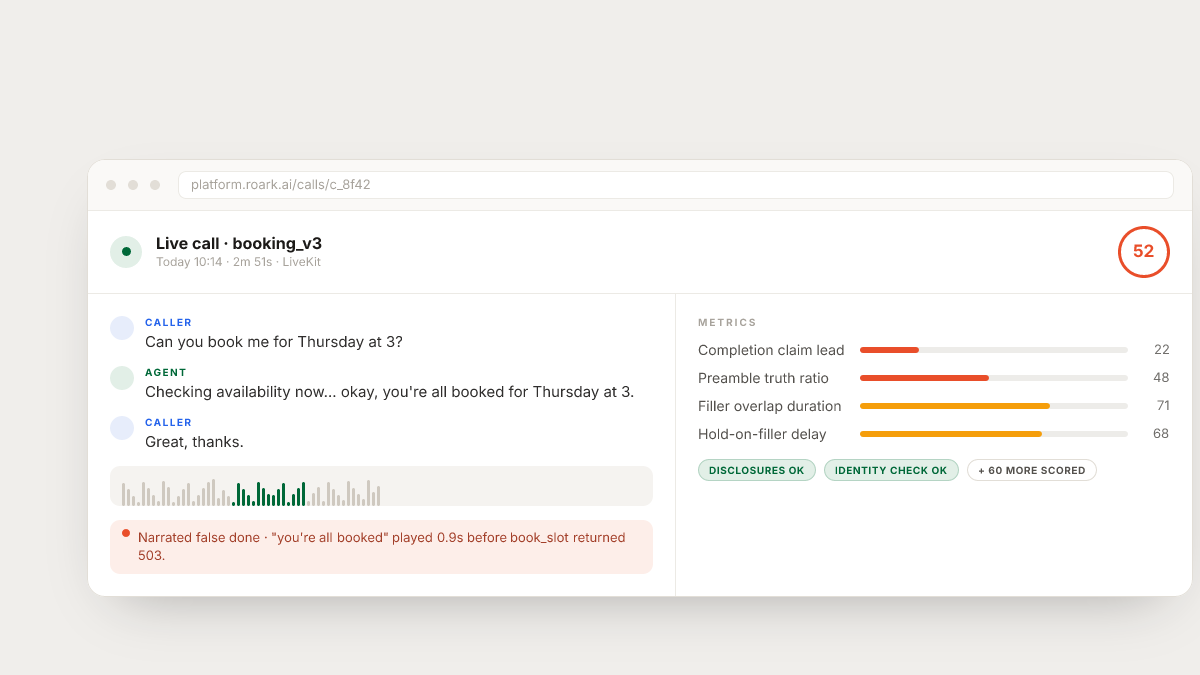
A transcript eval reads the finished conversation as a list of turns. It cannot tell you that the agent said "you're all booked" at t = 3.2 seconds and the booking tool returned a 503 at t = 4.1 seconds. It cannot measure the duration of filler-caller overlap. It cannot catch that the preamble "checking your calendar" played in English for a Hindi caller. It cannot tell the difference between a preamble that fired cleanly and a preamble that got stuck in a loop because the voice model kept re-emitting it on every heartbeat.
What breaks a narrated tool call is timing, audio, and the relationship between what the tool returned and what TTS played. You need a test harness that observes all three at once.
A simulation suite for narrated tool calls
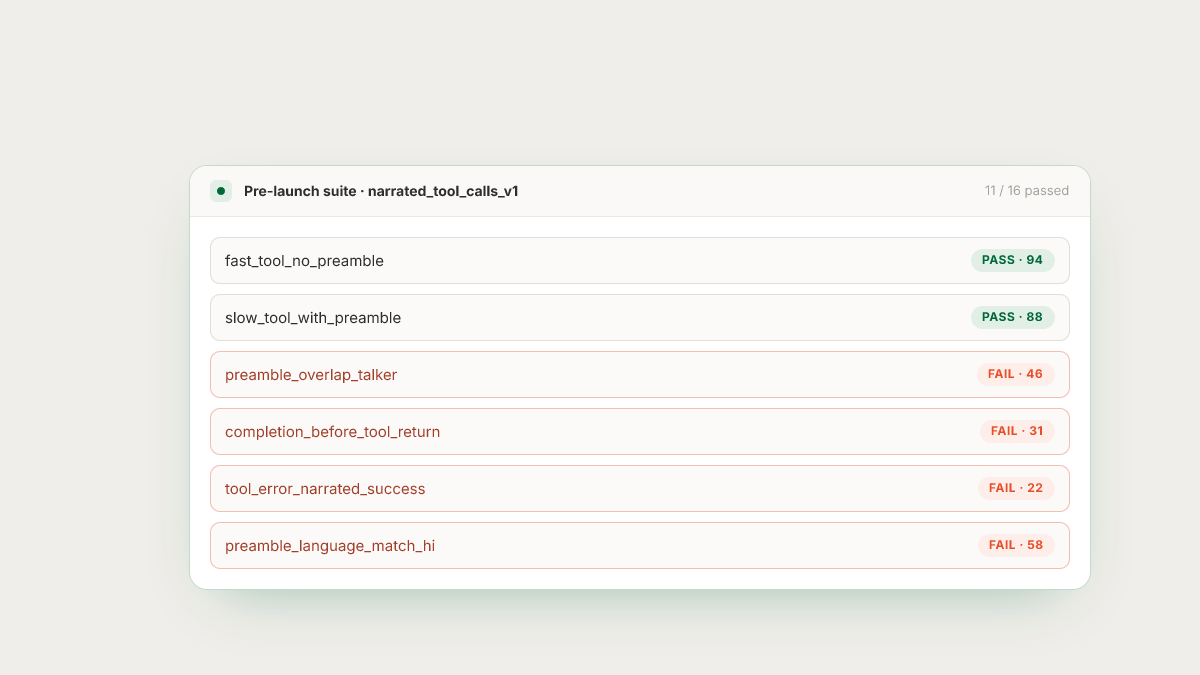
A useful suite runs against real telephony, not a text loopback. None of the failure modes above exist in text. Four axes to cover:
Tool speed classes. Include a fast tool (under 300 milliseconds), a typical one (1 to 2 seconds), and a deliberately slow one (5 to 10 seconds, with a timeout branch). Run each against the same suite. The preamble that is correct for the slow tool is a self-inflicted second of latency for the fast one, and the OpenAI docs call this out: avoid a preamble when the tool call is lightweight and the user would not benefit from an update.
Caller behavior during narration. Half your personas should talk over the preamble; a quarter should interrupt the progress narration mid-sentence; a quarter should stay silent. Each one reproduces a different bug. The talkers surface the Full-Duplex-Bench filler-overlap pattern. The interrupters test whether the agent cleanly cancels the in-flight narration or finishes the sentence into the caller's face. The silent ones catch the stall-on-filler case where nothing moves until the voice model's audio burst ends.
Tool outcomes. For every tool the suite calls, run a success case, an error case, an empty-result case, and a timeout. The question is not "does the agent handle errors," which a text eval can roughly answer, but "what did the agent say at the moment of the error." A narrated tool call that confidently reads out fictional availability from a failed lookup is a liability. GPT-Realtime-2 added stronger recovery behavior precisely for this, and it still needs a test that fires.
Language and accent coverage. The GPT-Live 1.1 release notes flagged that the previous version repeated a narrow set of English cues even on non-English calls. A preamble that fires in English on a Hindi call is a regression, and it only shows up if your suite dials the agent in the caller's actual language.
Metrics that score the narration, not just the filler
Whether the preamble fired is a binary. Whether the preamble was correct is a per-turn judgment. A useful metric set includes:
- Preamble truth ratio. Of the progress claims spoken before the tool returned, what fraction were consistent with the eventual tool result? Denominator is every narrated tool call in the run. This is the metric that catches narration-reality mismatch.
- Completion claim lead. Milliseconds between the agent asserting "done" (or "booked", or "sent") and the backing tool actually returning. Positive values mean the agent lied; negative is correct.
- Filler overlap duration. Total milliseconds of simultaneous speech between the agent's narration audio and the caller's audio, normalized per turn. The Ultravox 47.9 percent number is a metric shaped like this.
- Hold-on-filler delay. Time between tool result arrival and the next actionable utterance, isolated from any quiet-gate window. This is the stall-on-filler bug.
- Preamble language match. Whether the narration is in the same language as the current caller turn.
These are audio-native metrics. They need the recording, the tool-call trace, and a model that can time them against each other. This is the shape of what Roark does: simulate your agent over real phone calls, score every live call on 64 plus audio-native metrics plus any custom ones you add, and file an issue whenever a metric fails. Narration-reality mismatch is a custom metric you write once against your tool-call trace, then let run on every call forever.
Turning a bad call into a regression test
Narration failures do not usually detonate on the first run. They detonate when a model update widens the filler library, when an infra change adds 300 milliseconds to the quiet-gate window, when a tool backend starts returning in 80 milliseconds instead of 800. The right posture is to assume every bug will come back, and keep a replayable test for every case you have already seen.
Roark's production call replay captures the real call audio, the agent's speech, and the tool-call events, then replays them against your updated agent as a regression suite. When Tofu-1 moves out of research preview, when GPT-Live 1.2 ships, when you swap a Pipecat voice backend, your five worst narration failures from the last quarter rerun before the change goes live. If the completion claim fires before the tool returns a second time, you catch it in simulation instead of in a filed complaint.
The short version
The audible-progress feature is not optional anymore. Neither is the test that scores what the agent said while the tool was running, in the caller's language, timed against the trace. A voice agent that sounds smooth and lies confidently is worse than one that stalls and tells the truth. Only a simulation harness that watches the audio, the tool-call trace, and the caller's speech together can tell the two apart.